
Medical-gas copper tubing is not interchangeable with every ordinary copper plumbing tube simply because outside diameters match. The specification must control the correct material standard, manufacturing condition, clean internal surfaces, traceable supply and protection through storage and joining.
[EN 13348:2016](https://store.uni.com/en/uni-en-13348-2016) specifies requirements, sampling, test methods and delivery conditions for seamless round copper tubes for medical gas or vacuum applications. Its stated scope includes outside diameters from 6 mm to 219 mm and medical-gas operating pressure up to 2,000 kPa. [BS EN 13348:2016](https://www.thenbs.com/publicationindex/documents/details?DocId=314873&Pub=BSI) superseded the withdrawn 2008 edition. These are scope facts, not permission to use every diameter in every project.
Write a tube order that can be inspected
| Purchase information | Why it matters |
|---|---|
| Designated standard and edition | Makes the accepted material requirement unambiguous |
| Gas/vacuum service | Enables appropriate cleanliness and design review |
| Outside diameter and wall | Avoids assuming “22 mm tube” is a complete specification |
| Supplied lengths and condition | Defines handling, supports and fabrication expectations |
| Batch and markings | Connects delivered pieces to traceable production evidence |
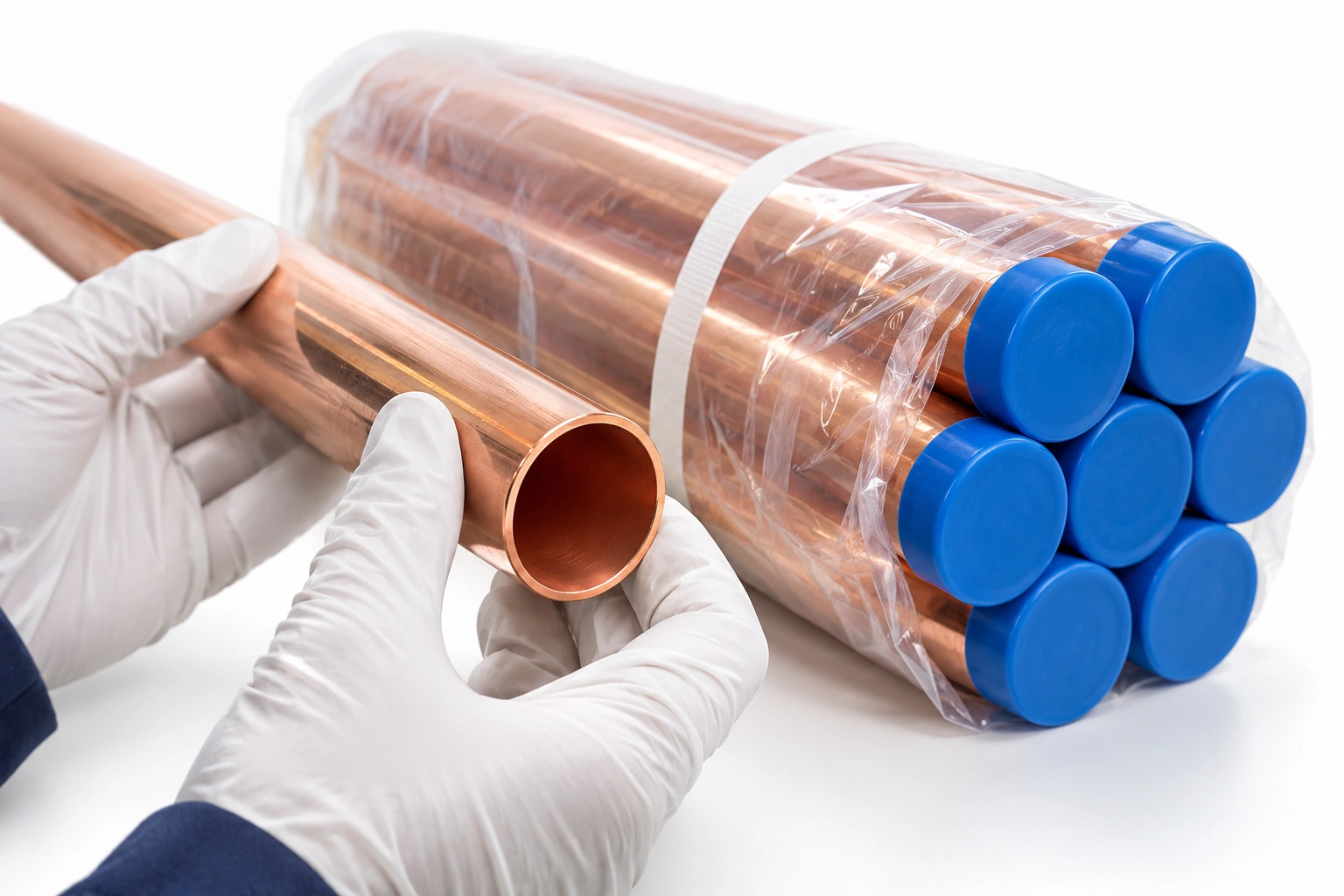
| End protection | Helps preserve clean internal surfaces during logistics |
| Inspection certificate | Records the agreed evidence for the supplied lot |
| Storage method | Prevents later contamination, damage or mixing |
Check packaging before the delivery is accepted
A sealed end cap is an important handling control, but a cap alone is not proof of acceptable internal cleanliness. The clean condition must remain supported by supplier process evidence and project-required inspection. Record missing seals, crushed ends, exposed tube bores and damaged identification before the material enters the installation area.
The pipework standard and the material standard address different scopes. ISO 7396-1 addresses pipeline design, testing and commissioning; tube dimensions and delivery requirements follow the adopted material standard. ISO 15001 supplies wider oxygen-compatibility context where applicable. A generic oil-free claim on a delivery note should not replace the project cleanliness acceptance plan.
Example: a mixed-size shipment
A hospital refurbishment orders 15 mm, 22 mm and 35 mm medical-gas copper tubes in separate batches. The delivery includes identical-looking tubes in loose bundles with partial labels. The receiving team should quarantine items whose batch or specification cannot be reconciled, rather than allocate them to ceilings based on visual size alone. Record tube and lot identities at installation and preserve the association with the relevant pressure test section.
Store and install without losing traceability
Inspect at receipt, place protected material in a clean designated store, keep end protection intact until controlled fabrication, then identify sections in the as-built record. Keep the approved joining method and flushing/commissioning records separate from the manufacturing certificate. Each answers a different verification question.
Do not specify an arbitrary pipe wall thickness from an internet chart. Work from the project calculations, the adopted edition and local design conditions, particularly for special pressure or nonstandard configurations.
Technical RFQ and BWC support
Ask suppliers for a line-by-line size schedule, standard edition, product details, lot evidence and packaging/cleanliness description. Separate material supply from site brazing, testing and release responsibilities. BWC Medgas medical copper tubing and installation accessories can be evaluated against the approved procurement schedule.
Send the medical-copper-tube bill of quantities to BWC Medgas.