A hospital buyer comparing two offers often recognises the company name before examining the component: one is a large international brand, the other a smaller or specialised manufacturer. The well-known brand may quote more, while the smaller supplier may promise faster customisation or a more competitive price.
Does a bigger company necessarily mean a better product? Does a smaller company necessarily mean lower quality? Neither conclusion follows. The meaningful differences are frequently engineering support, product scope, documentation, regional stock, local service, accountability and the precise manufacturing controls behind the supplied model.
Before discussing factories or OEM relationships, let's compare what buyers actually receive from these two types of business—and how to make a decision that protects a hospital project.
Large brands and smaller companies: where the real differences lie
A large medical gas brand often invests in product development, regulatory documentation, technical catalogues, regional distribution and after-sales support. That infrastructure can be valuable when a hospital needs an integrated project solution, rapid local replacement parts or one accountable service network.
A smaller manufacturer may focus on a narrower range, communicate directly with production engineers, customise drawing details quickly and carry less brand or distribution overhead. However, smaller does not automatically mean better priced, and a lower unit quotation may not include the services a hospital needs.
| Evaluation factor | Established international brand | Smaller or specialised manufacturer |
|---|---|---|
| Product range | Often broad, including integrated equipment packages | Often deeper focus on a few particular components |
| Engineering | May provide application design, technical submittals and project support | Can offer direct factory engineering and custom specifications |
| Quality | Must be proved by the exact product design, production control and tests | Must be proved using the same technical evidence |
| Market compliance | May already maintain market-specific regulatory resources | Must demonstrate applicable product-specific documents |
| Local support | May have distributors, warranties and ready replacement stock | Often depends on a partner, importer or contractor |
| Flexibility | Catalogue products with established options and approvals | Can offer alternate copper tails, connectors, markings or packaging |
| Total procurement cost | May include brand, channel, warranty and service costs | May offer a shorter supply chain; logistics and service still matter |
The brand premium is not always wasted money: sometimes it pays for real services. A smaller manufacturer's lower price is not automatically a compromise: it may reflect a different commercial structure. Separate these effects from the actual component quality.
How should a hospital, importer or MGPS contractor choose?
Compare products against one controlled purchasing specification, not against brochures alone. Before selecting a supplier, answer six questions:
- Are the items genuinely comparable? Identify the same gas service, model configuration, intended function, copper tail dimensions or regional terminal connector, and applicable technical criteria.
- What proves the product quality? Request relevant model-specific drawings, material requirements, inspection evidence, test results and traceability, not a catalogue claim.
- Does the offer meet the destination market's requirements? Check the local regulatory route, project standards and the roles of the manufacturer, importer and competent site verifier.
- Who will support the product? Consider spares, local response, repair arrangements, warranty and support during project commissioning.
- What is the true landed and lifecycle cost? Add shipping, duties, inventory, documentation, replacement lead times and potential downtime; do not compare unit quotations alone.
- Can the same quality be repeated across batches? An approved sample is important, but production control and changes to materials or tools determine whether later deliveries stay consistent.
Three buying situations
Complete hospital installation. If the hospital requires end-to-end engineering assistance, local service and system integration, an established brand or well-supported supplier may justify a higher total cost.
Experienced MGPS installation contractor. A specialist manufacturer may be a strong option when the contractor already controls installation, commissioning, local service and compatibility validation.
Import or private-label distribution. Factory responsiveness, approved drawings, stable manufacturing, documentation and replenishment may matter more than whether the factory name is widely recognised.
The right question is therefore not which logo is more famous, but which specific product and support arrangement meets the technical and commercial requirements with acceptable project risk.
A detail behind the brand: who actually makes the product?
Only after these comparisons does an important manufacturing question arise. A major brand does not necessarily manufacture every component inside its own factories. It may own the specification, brand and distribution relationship while commissioning a specialist manufacturer to produce the component under an OEM (original equipment manufacturing) arrangement.
A factory can therefore be relatively small yet manufacture components to demanding specifications established by a much larger customer. The brand and the manufacturer can each make a different contribution to the completed product.
But one factory does not guarantee one identical specification. Two visually similar products from the same facility may use different seal materials, connector dimensions, tolerances, cleanliness processes or inspection criteria. “OEM supplier” is a description of a commercial arrangement, not a quality certificate.
Can an OEM factory maintain quality to the same requirements as a major brand?
Yes, an OEM-produced product can meet the same defined product specifications and acceptance criteria as a branded product when the required materials, drawings, processes, inspection methods and release criteria are equivalent and consistently controlled.
But the word *OEM* by itself proves none of that. Two items can come from one factory and still be different if the private-label customer specifies different seals, connector tolerances, pressure ratings, surface finishing, cleanliness processes or inspection levels.
A buyer seeking equivalent quality should therefore request a technical equivalence review of actual models and configurations. A shared production address by itself is only one data point.
Seven checks behind an evidence-based comparison
| Verification item | What to compare |
|---|---|
| 1. Approved drawing | Dimensions, port/tail details, functional interfaces, revision and material list |
| 2. Material control | Base metals, seals and other gas-contact materials, and their traceability |
| 3. Process consistency | Machining, joining, assembly cleanliness, handling and controlled work instructions |
| 4. Product tests | Leakage, pressure/function, flow or pressure drop, mechanical performance as applicable |
| 5. Gas-specific integrity | Correct outlet and probe family, service identity and prevention of interchangeability |
| 6. Batch release | Inspection reports, lot identification, rejected-item controls and change history |
| 7. Delivery and support | Protected packaging, ordered configuration, spare compatibility and post-sale responsibility |
These checks can be applied regardless of company size. If two products do not share the same specification and evidence, calling them “the same quality” would be premature.
Why consistent OEM production matters more than a one-time perfect sample
A buyer rarely purchases only one sample. Hospitals and contractors need the 100th or 1,000th unit to remain consistent with the approved sample.
That requires change control, not just final inspection. If a supplier changes a seal material, connector tool, machining tolerance, copper tail source or assembly process, the technical impact should be reviewed before the change reaches a live order.
A sound OEM programme links the approved model to its controlled bill of materials, working instructions, inspection methods and traceable shipment. Purchasers should ask how a supplier manages nonconforming items, rework, lot records and revisions. These mechanisms—not the manufacturer's size—determine whether the stated quality can be maintained over time.
A fair price-and-support comparison
Imagine two offers for a hospital terminal-unit replacement. One uses a familiar brand and has good local availability; the other comes from a specialist OEM at a lower unit price.
If the OEM cannot demonstrate the exact gas-specific connector, the required tests or the correct replacement interface, the lower number should not determine the purchase. If it can demonstrate the required specification and quality evidence, and the buyer has competent local integration, documentation and service support, it may offer an efficient alternative.
The correct comparison is total procurement value, including product conformity, continuity of supply, project risk, spare parts, logistics, importer responsibilities and after-sales support—not unit price alone.
Product focus 1: Medical gas line valves with copper tube tails
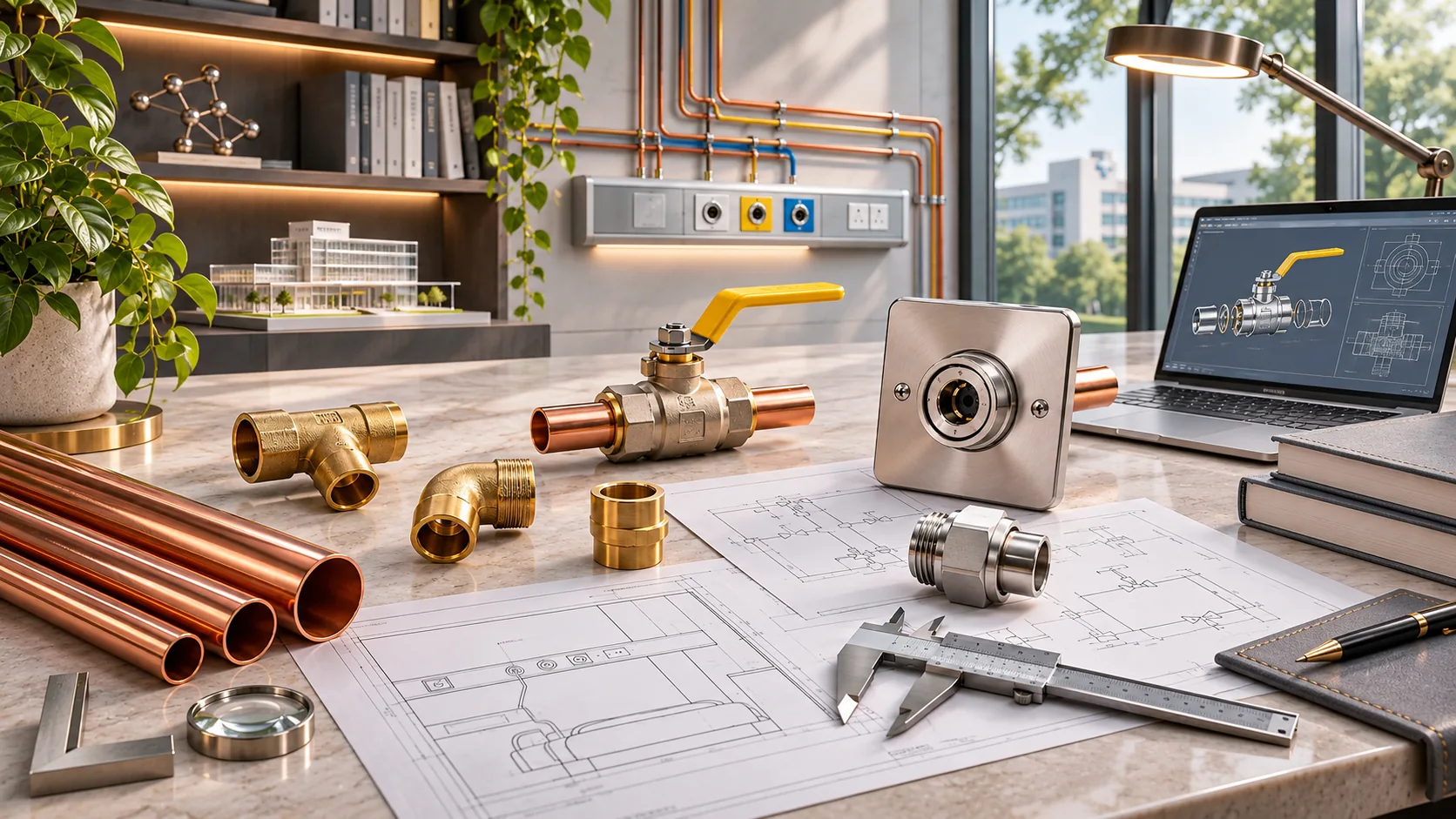
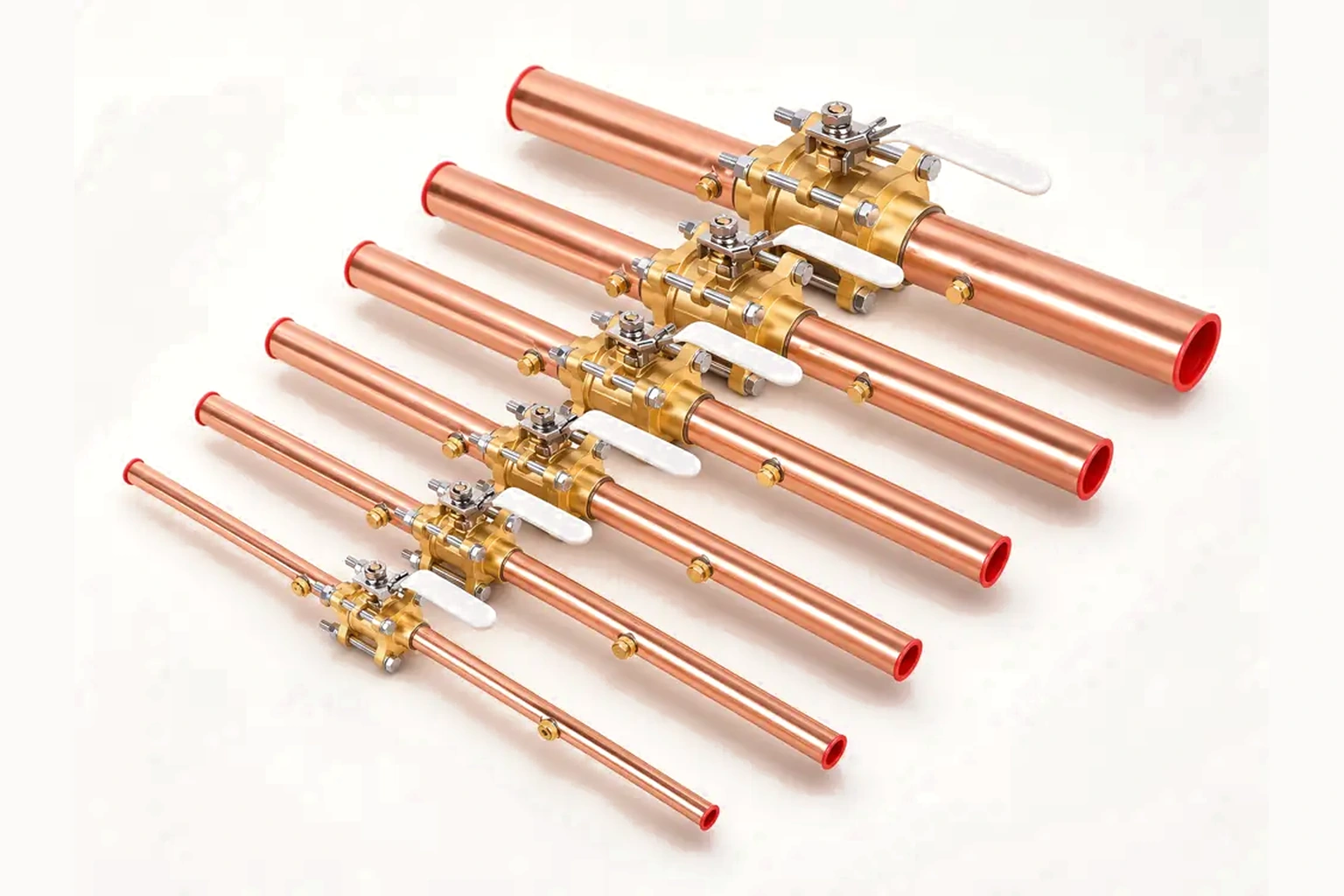
The first photograph shows BWC's line valve assemblies in several sizes, with copper tube extensions and lever handles. This type of configured assembly is relevant where MGPS designers and installers specify valves with defined connecting tails for medical-gas piping projects.
For an informed comparison, inspect the actual valve assembly, not just the valve body. Important purchasing details include the selected gas service, intended pressure and isolation function, copper tail dimensions and joining arrangements, seal materials, manufacturing condition, leakage evidence, cleaning/protection and the applicable drawing revision.
Two valve assemblies can look almost identical but have different internal sealing arrangements or end configurations. For oxygen service, material and cleanliness controls matter particularly. ISO 15001:2010 addresses oxygen compatibility including cleanliness and ignition risks, while the pipeline application falls under the locally adopted edition of ISO 7396-1.
What to send BWC: gas service, required valve size, copper tube outside diameter and length, connection drawing, quantities, site country and the project's accepted standards and inspection requirements.
Explore BWC medical gas valves and medical copper tubing and fittings.
Product focus 2: Medical gas terminal units
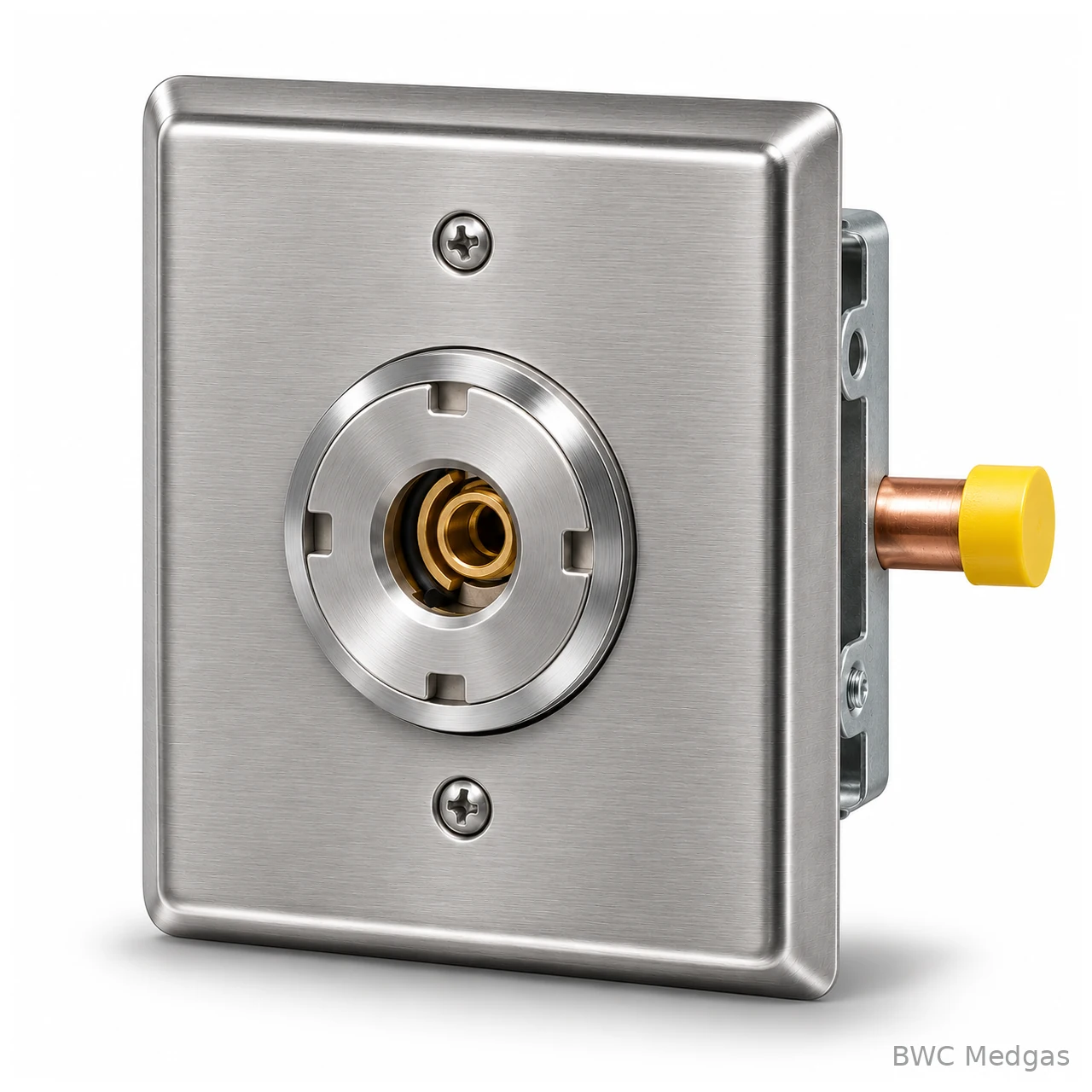
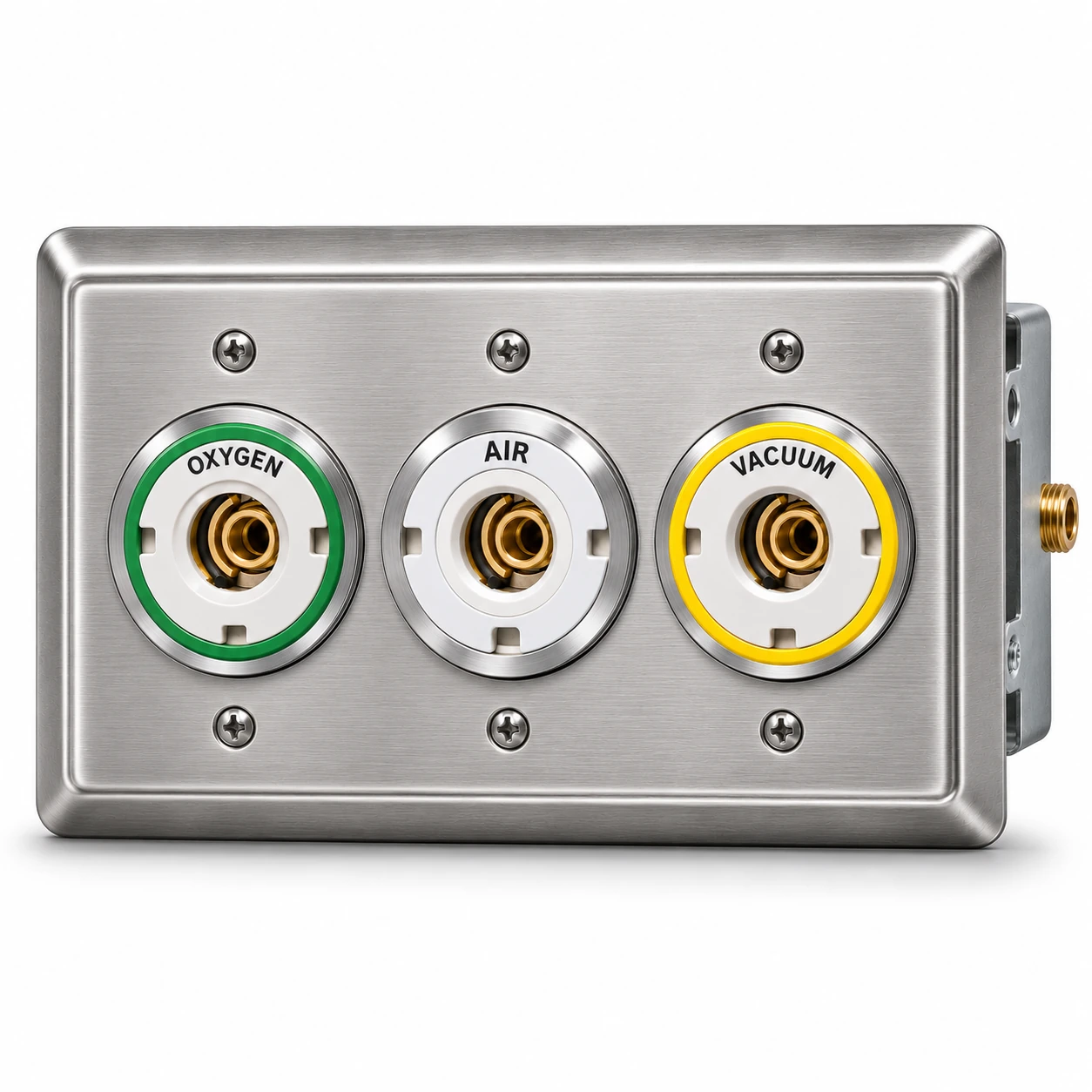
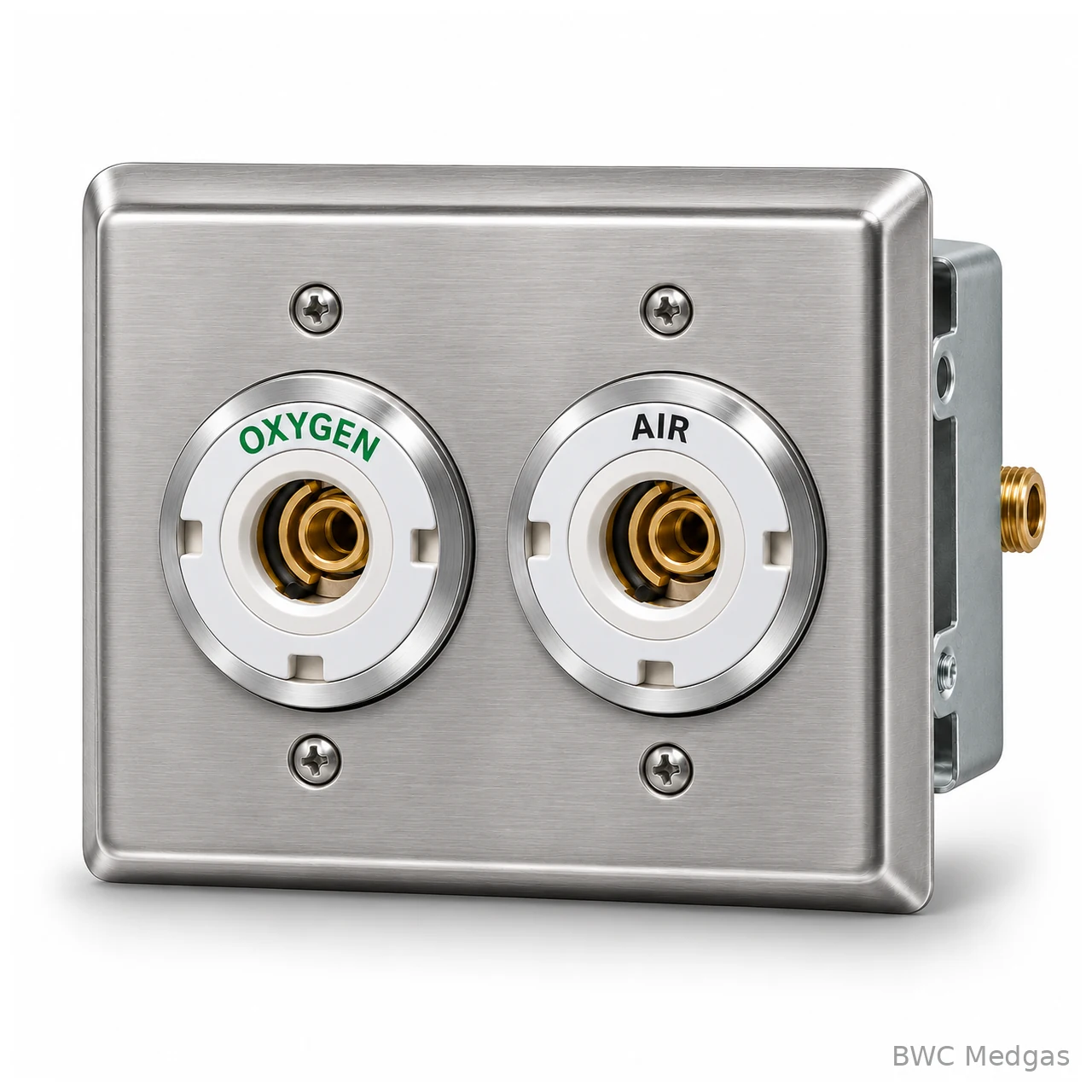
The second photograph shows sample terminal-unit fronts marked for oxygen, medical air and vacuum. These are precisely the products where appearance is a poor substitute for technical comparison.
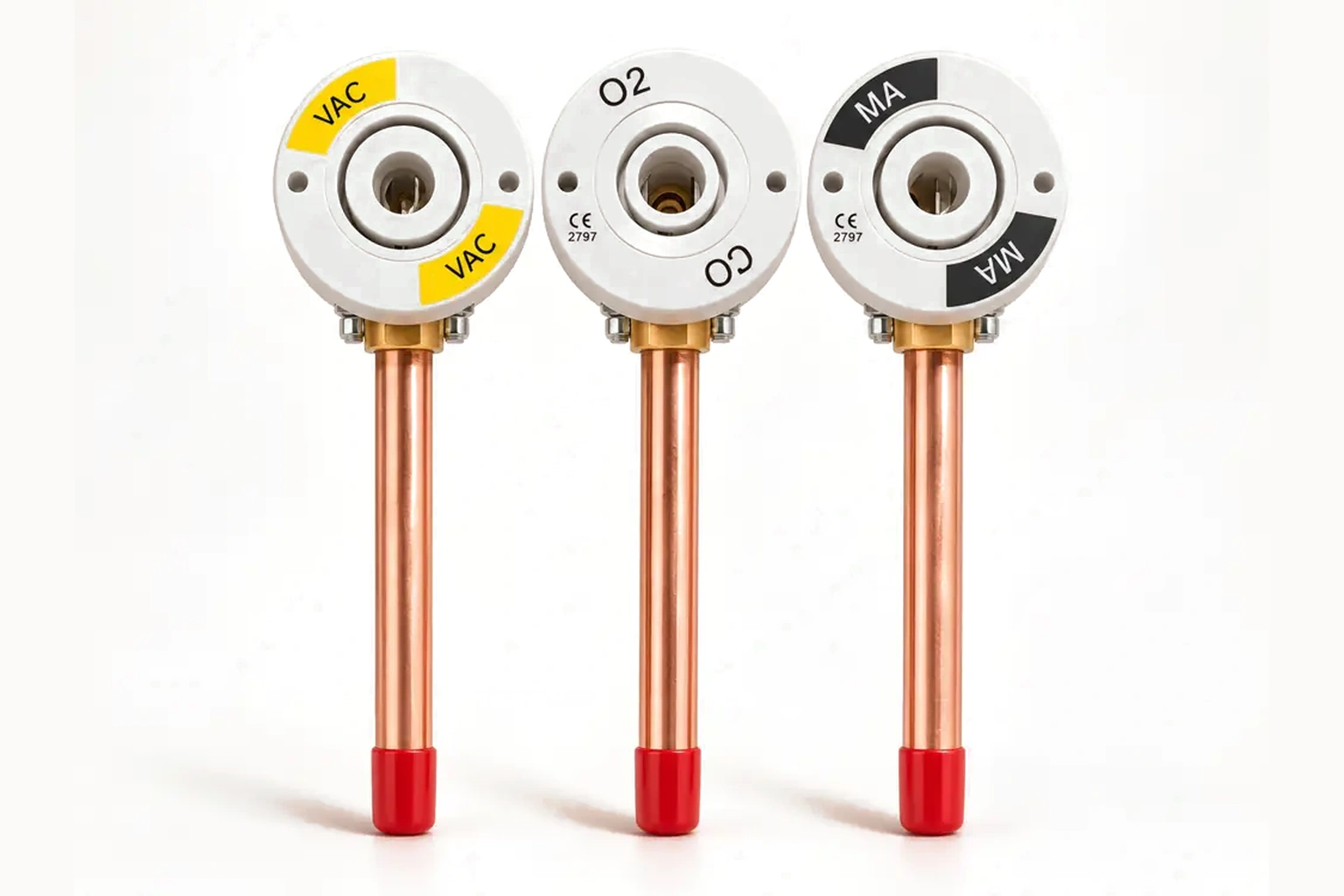
The relevant ISO 9170-1:2017 addresses gas-specific assembly, non-interchangeability, mechanical performance, leakage, flow and pressure drop of terminal units. Importantly, it does not define every national connector dimension. A hospital must still specify the correct regional connector family and approved mating probe.
In a terminal-unit comparison, a buyer should establish the actual gas service, national interface family, complete front and rear assembly, inlet tail, locking/release operation, specified functional performance, spare-part compatibility and installation format.
A sample labelled “O2” does not automatically match the oxygen probes already used by a hospital. Similarly, a terminal for vacuum must not be treated as a compressed-gas outlet merely because the mounting format looks familiar.
What to send BWC: required services (for example O2, MA and VAC), connector family or an approved probe sample/drawing, wall or pendant mounting, inlet details, quantity by service, and model-specific acceptance requirements.
Explore BWC medical gas terminal units.
BWC Medgas: applying OEM manufacturing expertise to core MGPS components
BWC Medgas concentrates on manufacturing and supplying specified MGPS components. We support OEM and private-label enquiries with attention to approved configurations, repeatable production and technical communication. Where a customer needs a particular connector, copper tail arrangement or marking, the proposed design must be agreed before production.
We can discuss requested drawings, samples, model compatibility, production batches, relevant inspection evidence and commercial supply terms. Specific conformity documents and acceptance criteria should always be matched to the ordered model, configuration and destination market.
Our position is straightforward: quality should be comparable through evidence, not slogans. Buyers should judge a BWC component by the same performance, material, cleanliness, traceability and consistency questions they would apply to a recognised brand.
If you are an MGPS installer, distributor, healthcare equipment importer or OEM buyer considering a better sourcing route for line valves or terminal units, send your component schedule to BWC Medgas.
Frequently asked questions
Does OEM mean the product is identical to the branded version?
No. OEM describes a manufacturing relationship. Identical quality or interchangeability requires comparison of the actual approved models, materials, interfaces and acceptance evidence.
Can smaller manufacturers deliver the same component quality?
They can, when the same defined product requirements and effective production controls are met. Neither the company size nor the price alone establishes the result.
Is a CE mark or an ISO 13485 certificate enough?
No single general certificate proves every configuration is appropriate for a hospital project. Buyers need the product-specific legal/regulatory route, interface requirements and supporting evidence relevant to their destination market and contract.
Should hospitals buy directly from a factory?
That depends on the hospital's procurement rules, local importer obligations, documentation, installation, service and warranty needs. Many projects benefit from a specialist factory supplying through an established local engineering partner.