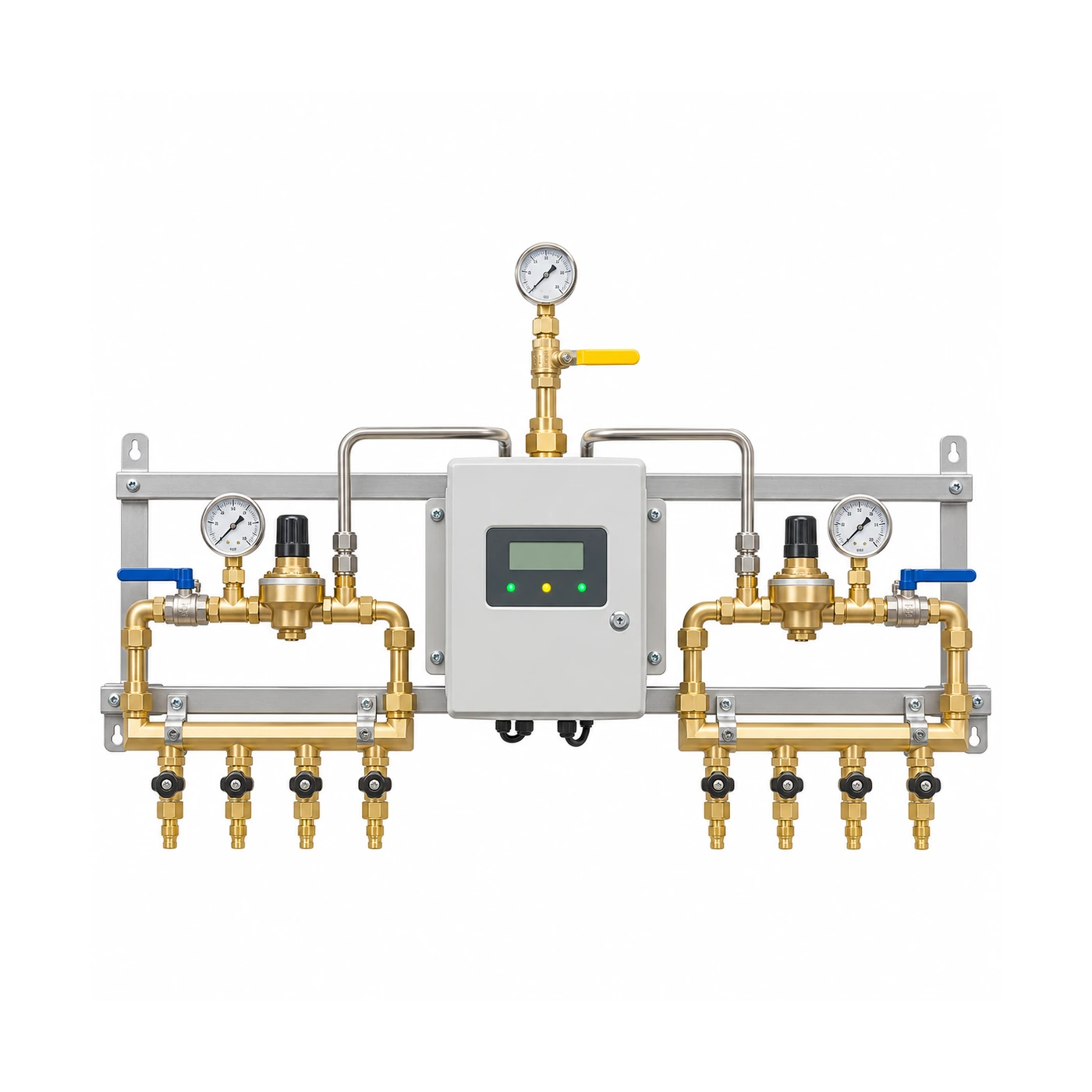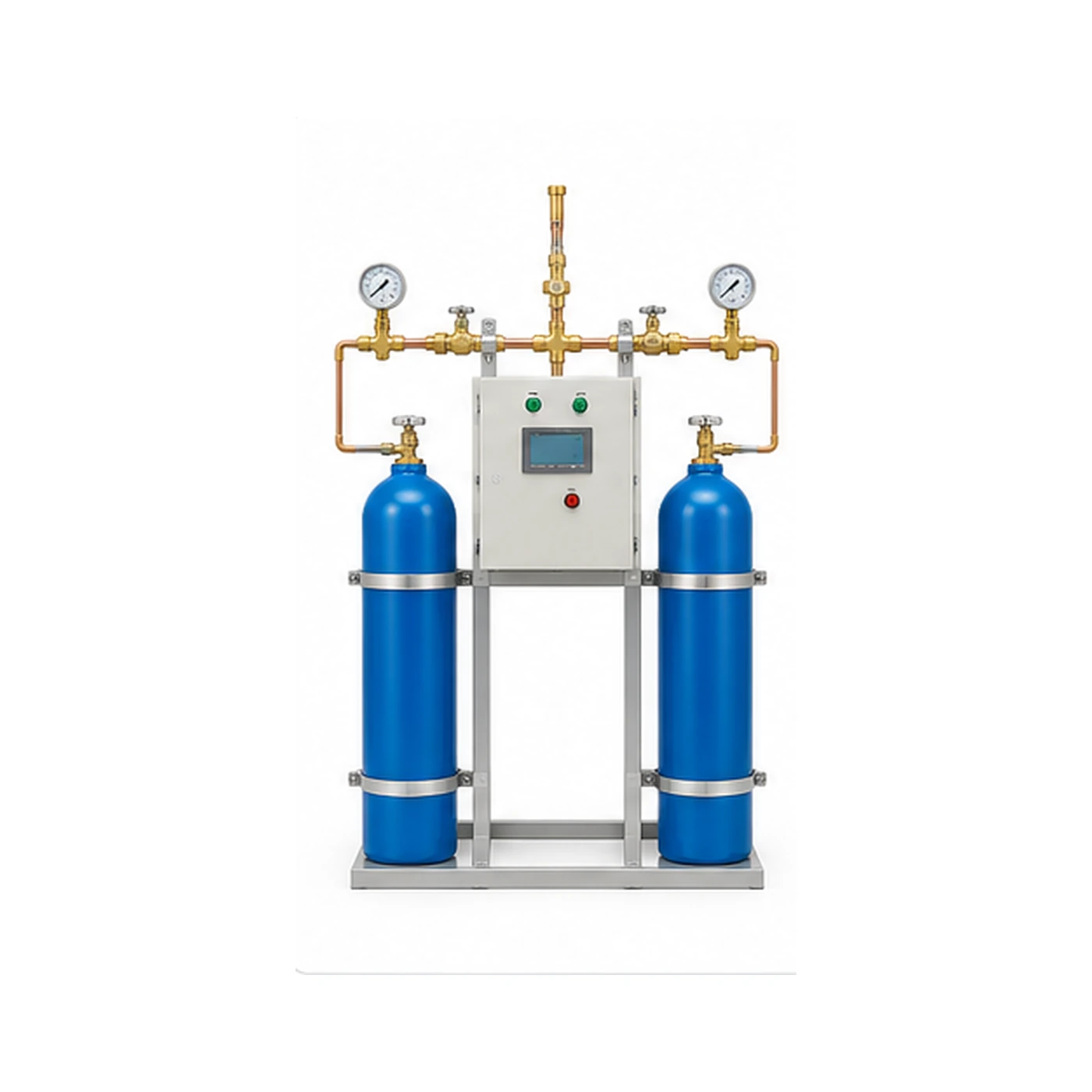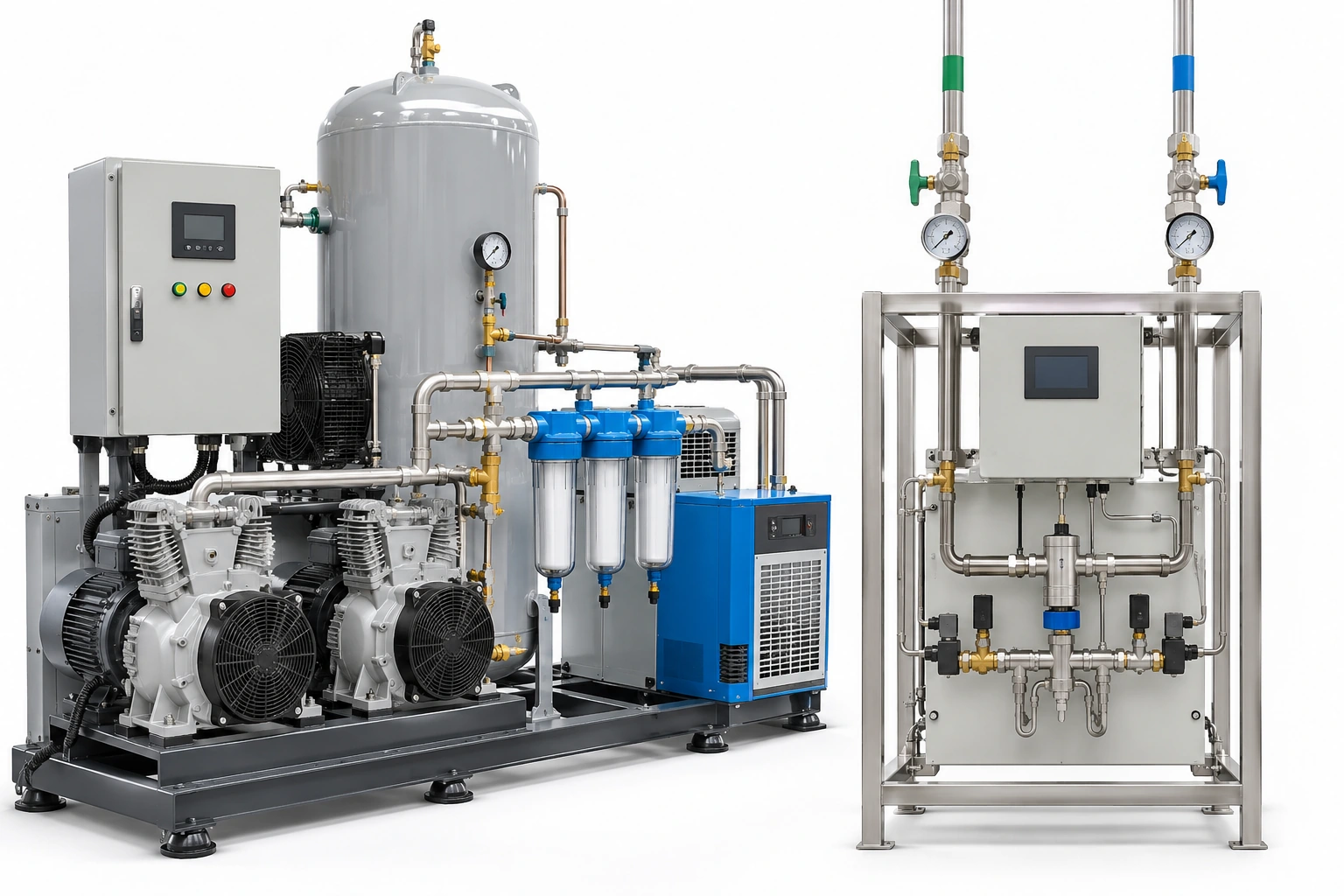
“Medical air plant” is an ambiguous purchase description. One project might require a compressor-based source with appropriate air treatment; another might use a proportioning arrangement that blends oxygen and nitrogen to manufacture synthetic medical air. The intended product and the approved source architecture must be defined before the purchaser compares a compressor advertisement with a blending-unit quotation.
The distinction now matters even more because ISO 7396-3:2025, published in July 2025, specifically addresses proportioning units for synthetic medical air. It does not replace the system-level requirements of ISO 7396-1:2016.
Distinguish the product from its manufacturing method
Medical air for administration to patients is a defined medical gas product, subject to the applicable quality specification and local rules. Air for driving surgical tools can be a separate service with different engineering and intended-use requirements. The project must not treat “compressed air,” “medical air” and “surgical air” as synonyms.
A compressor-based medical-air source derives air from the environment and needs suitable processing/quality assurance. A synthetic medical-air source uses controlled blending of oxygen and nitrogen. The equipment may look different, but both must be considered within the hospital's approved medical gas system and quality governance.
Identify precisely which medical gas or tool-driving service the proposed equipment is intended to supply.
What ISO 7396-3:2025 addresses
The ISO 7396-3:2025 official abstract states that the standard concerns construction and operation of proportioning devices that produce air by blending oxygen and nitrogen. It applies to proportioning units used as components of a medical air supply system that feeds an MGPS compliant with ISO 7396-1.
The publisher explicitly notes that the number and combination of sources needed to form the medical air supply system lie outside the scope of ISO 7396-3; those source-system requirements are in ISO 7396-1. This is a crucial purchasing distinction.
Buying a proportioning skid does not mean the hospital has procured the entire compliant source arrangement.
What to check for a compressor-based proposal
The engineering and quality team should request:
- Intended medical-air service and specified product quality.
- Approved design duty and relevant performance cases.
- Compressor and air-treatment arrangement, with scope clearly listed.
- Inlet location, environmental conditions and potential contaminant exposure.
- Monitoring, quality control and alarms appropriate to the project.
- Utilities, energy use, redundancy/maintenance arrangements and access.
- Source outlet/interface details, including any connection to the medical air distribution.
- Maintenance, spare parts, inspection, calibration and training obligations.
Do not use a generic industrial compressed-air purity class as a complete substitute for the medicinal-gas specification required by the facility.
What to check for a synthetic-air proposal
Request the exact proportioning unit classification, input oxygen and nitrogen product specifications, availability and quality responsibilities, monitoring arrangements, plant utilities, interfaces and applicable equipment documentation.
The design authority must address what happens when an input gas or the proportioning function is unavailable, and how that relates to the wider source system. The procurement team should not guess a source combination or reserve strategy from a product brochure.
Build a source-by-source responsibility table
Each input/product may involve separate suppliers and site owners. Create rows for input gas quality, production/processing unit, quality monitoring, source outlet, distribution connection, planned maintenance, failure response and document handover.
For each row record who designs, provides, operates, monitors, verifies and signs off the activity. A factory demonstration cannot replace site responsibilities. Under ISO 7396-1, on-site gas manufacture places important quality obligations on the healthcare facility, subject to local regulation.
Compare offers without masking differences
Ask bidders for scope statements matching the same output service and approved duty. Compare not only capital price but ongoing gas inputs or electricity, monitoring, maintenance, spare equipment, local skills and life-cycle responsibilities.
If one quotation includes all treatment, measurement and backup provisions while the other includes only a compressor or mixer, the two prices are not comparable.
Practical example: conflicting RFQ titles
One purchasing spreadsheet says “medical air compressor 6 bar,” while the drawing describes a synthetic air blending system. The correct remedy is not to choose a pressure-compatible compressor. Reconcile the intended source technology, medical gas specification, system duty and approved scheme before procurement.
A technical clarification can ask: “Are we purchasing a compressor-based medical air source, a synthetic medical air proportioning unit, or only downstream accessories?” This question prevents an entire category of misquotation.
BWC Medgas product boundary
BWC supplies selected medical gas components rather than complete compressor plants or synthetic-air generation systems. After the source equipment is defined, relevant components may include gas-specific outlets, medical gas regulators, isolation valves or alarm-related hardware.
Send a specification-led medical air component enquiry to BWC Medgas.
FAQ
Does ISO 7396-3 replace ISO 7396-1?
No. Part 3 covers proportioning units, while Part 1 governs the broader medical gas pipeline supply system.
Is ordinary workshop compressed air equivalent to medical air?
No. Its intended use and quality requirements cannot be assumed equivalent.