
A hospital MGPS may include pressure regulation at a cylinder manifold and further pressure control downstream in the distribution system. Purchasing both devices as the same generic “medical oxygen regulator” confuses duty, testing and continuity requirements.
A useful procurement deliverable is a stage-by-stage source-to-network regulation register. It connects each regulator's actual function, pressure envelope, demand case and required standby/recovery arrangement to the project-approved P&ID.
Identify each stage, not merely each pipe size
A manifold regulator handles incoming conditions associated with its specified source. A line regulator operates in the intended downstream stage. ISO 10524-2:2018 explicitly covers both and differentiates their intended inlet-duty envelopes. It does not cover medical vacuum pipeline regulators; these belong to a different technical context.
Create a unique equipment ID for every individual regulator or assembly. An integrated source panel still needs a functional definition for its internal pressure-regulating components.
Make the P&ID and purchased bill agree
The approved schematic should specify flow direction, equipment position, regulator type and stage, approved relief/monitoring provisions and the required isolation/maintenance concept. The purchase schedule translates that design into exact model, gas identity, connections and rated performance.
A vendor diagram showing one attractive control panel does not prove all required source and reserve functions are included. The buyer should resolve each interface before comparing offers.
Regulation-stage handover register
| Field | Stage-specific question | Evidence required |
|---|---|---|
| Regulator ID | Which exact component is involved? | Manufacturer/model, asset tag |
| Source role | Manifold or downstream line duty? | Approved P&ID |
| Inlet envelope | What conditions can this stage actually receive? | Design and manufacturer limits |
| Outlet demand | What flow/pressure scenarios must it serve? | Approved duty/curve review |
| Parallel/standby path | What design-approved continuity is required? | Source architecture |
| Monitoring | What measured state or alarm belongs to this stage? | I/O and alarm schedule |
| Service access | How is maintenance planned without compromising care? | Operational policy |
| Acceptance | Which factory and site records prove performance? | Commissioning index |
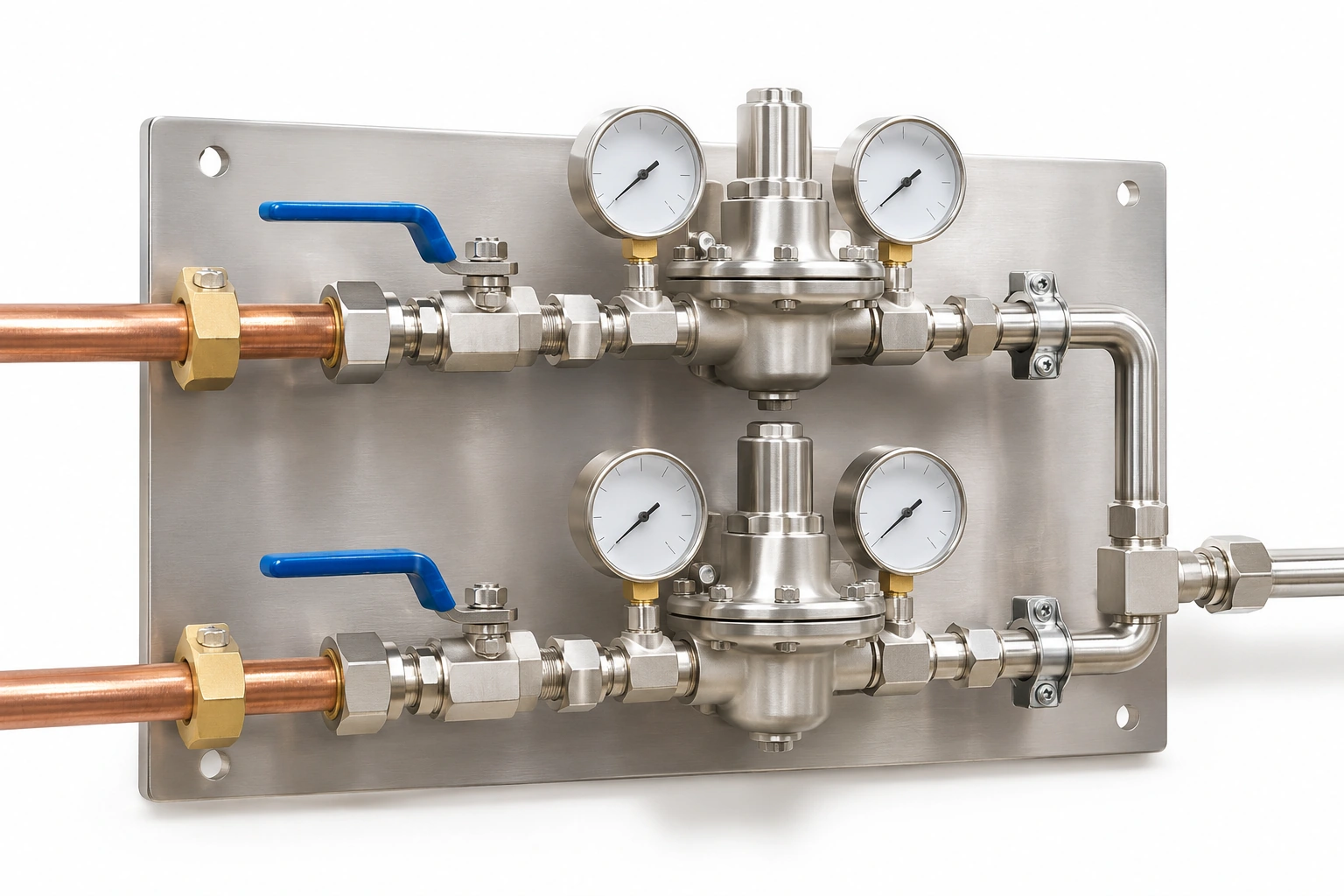
Do not infer a parallel regulator is standby simply because a second valve body appears in a cabinet. Actual routing and control intent need an approved description.
Account for source depletion and changing demand
Cylinder banks and source equipment can present changing upstream conditions. The design should specify the intended minimum inlet condition and demand at which a regulator must maintain acceptable downstream behavior.
A regulator specified only at full source pressure may have an untested weak point near source changeover. Vendor evidence must cover relevant operating limits.
Distinguish continuity from a bypass
Hospital supply continuity belongs to the source and pipeline system design under ISO 7396-1. A visible bypass pipe does not by itself establish safe redundancy or authorized use. Never recommend a field bypass or adjusting an alternate path to overcome a device problem.
If a proposed arrangement changes approved operating paths, obtain project-level engineering and healthcare authorization.
Realistic tender discrepancy
Two suppliers offer “dual regulator manifold panels.” Proposal A contains two regulated branches with clearly defined normal and standby roles; Proposal B uses two regulators in different pressure stages. Both include two regulators but are not the same architecture.
Request a function map and controlled schematic, then compare pressure duty, monitoring, transfer/contingency roles and tests. A count of two is commercially misleading without design context.
Separate product evidence from site commissioning
A factory unit can be tested at the relevant manufacturing boundary, while final system verification needs the actual installed source, piping, alarms and permitted acceptance conditions. Record the test ID, unit tag, witness and deviation closure.
The 2026 NHS HTM 02-01 and Scottish SHTM 02-01 provide installation, verification and operating frameworks. They do not authorize unsupervised intervention in an occupied hospital.
Procurement scope and life-cycle support
Request model-specific test reports, gas-contact material and oxygen cleaning evidence where relevant, spare regulator assemblies, pressure indication, service instructions, delivered labeling and source/line interface drawings.
BWC Medgas supplies selected manifold assemblies/components and medical gas pressure regulators to an approved source-stage schedule; source system design and operational approval remain the hospital project's responsibilities.
Discuss a stage-specific regulator component schedule with BWC Medgas.
Frequently asked questions
Does a second regulator guarantee uninterrupted medical oxygen service?
No. Redundancy requires an approved full system arrangement, monitoring and operational design.
Can a regulator specified for a line be used directly at the cylinder manifold?
Not without verifying its exact approved inlet duty and intended use.