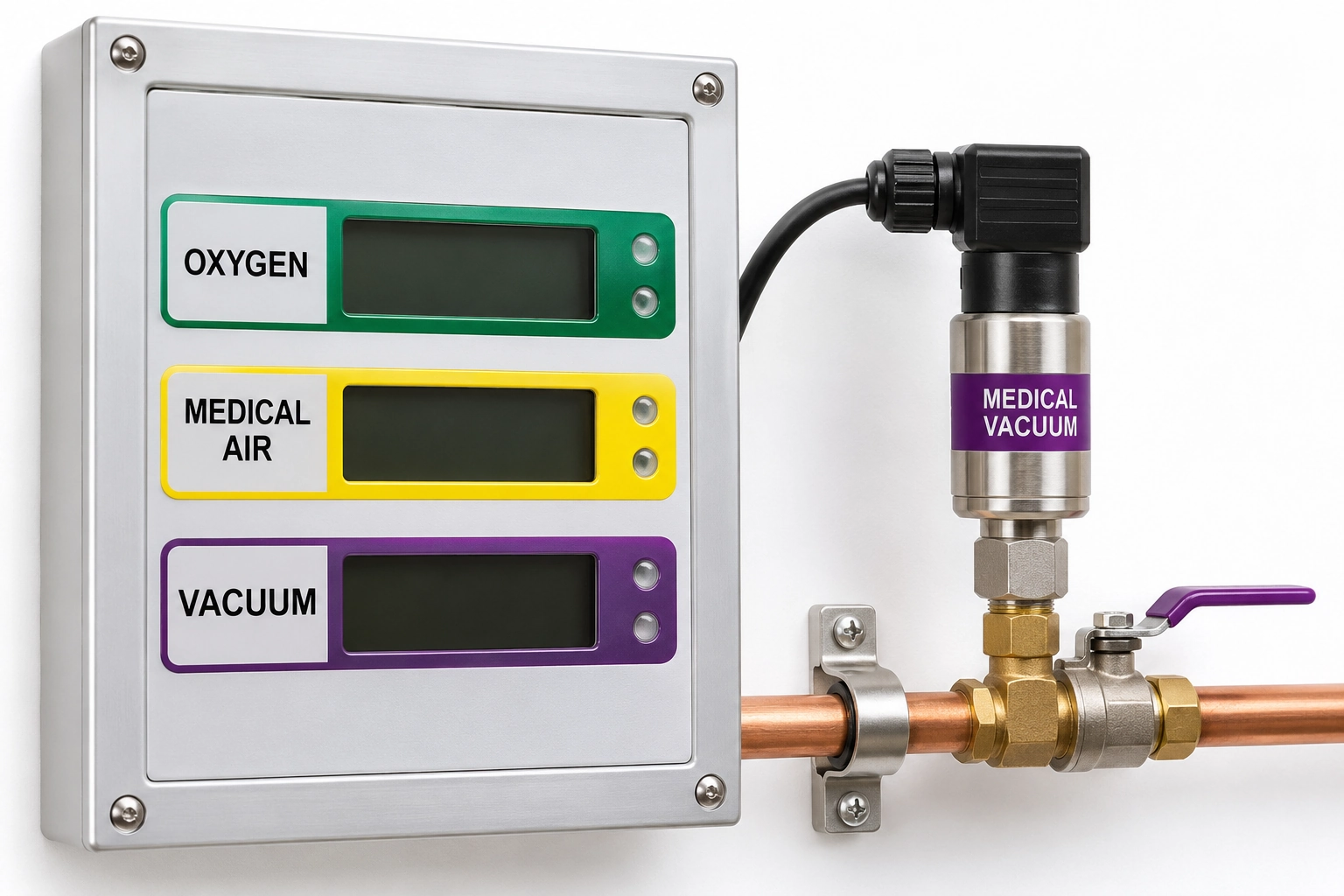
Vacuum alarms are often included as one channel in a multi-service medical gas panel. They are particularly vulnerable to wrong assumptions because a vacuum is not displayed in the same physical conventions as a positive-pressure gas. A plausible numeric reading can still be misinterpreted if the sign, absolute/gauge basis, units or monitoring point is unclear.
A vacuum-monitoring review sheet should make the intended physical condition, sensing location and approved panel indication explicit. A vacuum alarm is not an instruction for clinical staff to adjust suction devices or manipulate the plant.
Define the intended monitored service
Medical vacuum is part of the installed MGPS, whereas a patient-side suction regulator or collection device is downstream equipment with a distinct function. A source-plant vacuum condition and a ward-branch vacuum condition can represent different engineering states.
The ISO 7396-1:2016 system scope includes medical vacuum, control, alarm and verification. The site designer decides which physical points and conditions are required under the adopted project specification.
Establish units and sign convention before purchasing
A vacuum may be expressed as negative gauge pressure, absolute pressure or another instrument-specific representation. Simply applying a minus sign to a positive gas sensor specification is not valid instrument selection.
Record which quantity is physically measured, the output scale, the displayed units, the approved operating/abnormal ranges and how a loss of vacuum is represented. The display should not leave clinicians or engineers guessing whether “higher number” means stronger or weaker vacuum.
Build a dedicated vacuum signal list
| Item | Required determination | Common risk |
|---|---|---|
| Source/area location | Exact vacuum plant or relevant pipeline tap | Wrong zone/plant shown |
| Measurement basis | Absolute/gauge and sign/units | Confused alarm interpretation |
| Sensor model | Vacuum-capable suitable device and materials | Positive-only device assumed |
| Alarm definitions | Approved condition and response route | Generic pressure thresholds |
| Panel label | Explicit vacuum service and location | Lost identity in multi-gas panel |
| Fault behavior | Sensor/disconnected/invalid status | Fault presented as normal |
| Site evidence | Approved functional verification and witness | Only factory test available |
Do not copy nominal clinical suction values into the MGPS vacuum sensing specification; they describe different equipment boundaries.
Make the sensor location auditable
A sensor at the central vacuum source cannot automatically prove the duty at a remote clinical branch. Likewise, an area indication may not provide all the plant equipment conditions needed by engineering staff.
The approved network P&ID should identify each measurement's exact pipeline reference and purpose. Where multiple branches share a controller, the source-to-panel point mapping must be checked service by service.
Keep alarm thresholds under design control
The correct abnormal condition depends on the approved medical vacuum system design and the adopted standards. Do not prescribe a universal trigger number in kPa, bar or inHg without the system specification.
Request the approved functional description, instrument range, indicated event text, required receiving locations and acceptance method. Vendor demonstrations with arbitrary sensor inputs are not themselves hospital verification.
Example: the inverted alarm label
One supplier offers a screen that displays a large positive number as “vacuum strength,” while the hospital specification lists negative gauge pressure. The engineering team must reconcile sign, units and what constitutes an unacceptable decline before accepting the display mapping.
This is not a cosmetic issue: a wrong meaning can prevent accurate interpretation and response.
Link plant and terminal-side records
NHS Scotland's 2026 SHTM 02-01 includes separate medical vacuum plant Form A13, area alarm Form A14 and central alarm Form A15. These concern distinct physical duties and should be linked in the handover dossier where applicable.
The supplier's pressure sensor certificate does not replace the complete required installed-system performance/identity checks.
Maintenance, data logging and defect traceability
Keep records of exact sensor model, service, calibration basis, installed zone, panel channel, maintenance events, reconfiguration and applicable post-work verification. When a vacuum source or pipeline branch is modified, review affected alarm descriptions and receiving locations.
A repeated low-vacuum warning might involve source plant, distribution or equipment interfaces. Competent personnel must determine the actual cause from system records and authorized investigation, not an online symptom chart.
BWC Medgas components
BWC can discuss selected medical gas alarm/monitoring components and vacuum-related indication devices against exact project drawings and measured-quantity definitions.
Send your vacuum monitoring points and alarm schedule to BWC Medgas.
Frequently asked questions
Can a positive-pressure transducer always be used for vacuum by changing software?
No. The device and measurement range must be suitable for the intended physical quantity and service.
Does a normal vacuum source panel prove every ward outlet works?
No. System and point-of-use verification are distinct.