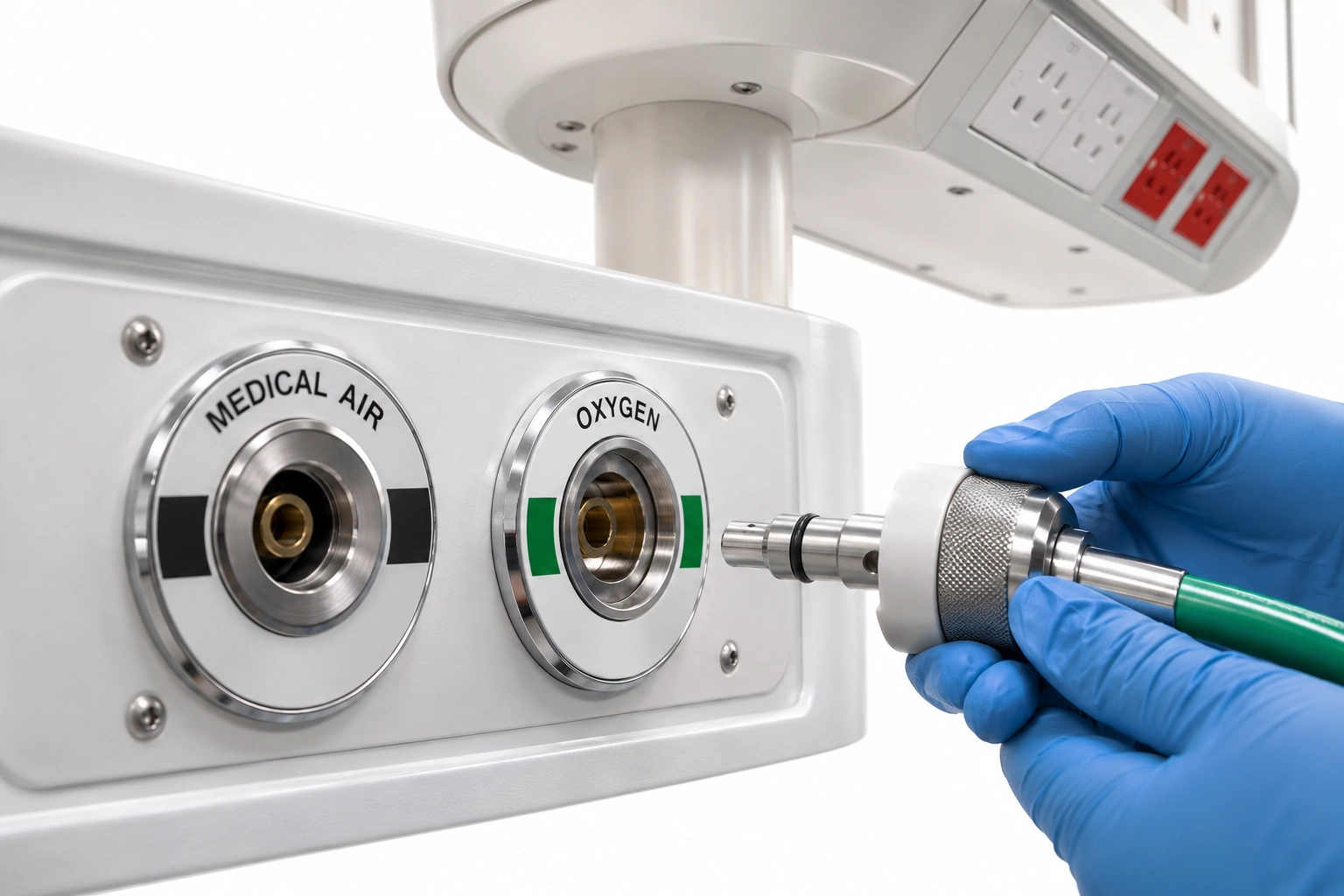
A newly fitted hospital gas outlet can be perfectly aligned, cleanly mounted and still be the wrong service for the room or incompatible with the approved probe. Visual similarity is a poor substitute for gas-specificity and installed-function evidence, especially when contractors replace several terminal types across multiple departments.
The 2026 Scottish SHTM 02-01 distinguishes Form A6 for pendant/miscellaneous NIST connector specificity and function, A7 for terminal unit schedule, cross-connection and gas-specificity tests, and A8 for terminal unit functional tests. They describe related but different questions.
Identify the actual terminal model and installation
Keep the room number, bed/theatre position, gas or medical vacuum identity, manufacturer model, probe interface family, mounting assembly and installed connection route in a controlled schedule. When a terminal belongs to a pendant or medical supply unit, its enclosing equipment and manufacturer responsibilities should also be identified.
ISO 9170-1:2017 addresses terminal units for compressed medical gases and vacuum, including gas-specific assembly, mechanical performance, flow, pressure drop, leakage and resistance; it does not itself prescribe every country's probe dimensions.
Terminal verification worksheet
| Evidence | Project-specific requirement | Owner |
|---|---|---|
| Asset location | Exact room/bed, wall or pendant and gas-service ID | Installer |
| Terminal model | Manufacturer, version, connection type and included parts | Supplier/biomedical |
| Correct service | As-built branch serving the terminal | Qualified MGPS verifier |
| Specificity | Approved gas-specific matching/non-matching inspection | Qualified tester |
| Function | Applicable installed terminal performance | Commissioning team |
| Pendant connector | Relevant NIST and enclosing medical supply unit interface | Equipment assembler |
| Test instrument | Exact equipment and valid calibration | Test witness |
| Release | Accepted result, defect closure and hospital authority | Project owner |
Do not mark a room “completed” when several terminals remain untested or have their service names interchanged.
Separate device tests from pipeline tests
A manufacturer's terminal conformity to ISO 9170-1 does not establish that the correct hospital pipeline is connected behind its rear connection. Site acceptance verifies the as-installed arrangement, which can be wrong despite correctly manufactured parts.
Conversely, a complete pipework pressure test will not necessarily detect incorrect terminal gas identity or an incompatible probe family.
Medical supply units create a second equipment boundary
A ceiling pendant or prefabricated service column is equipment in its own right. ISO 11197:2019 is the published edition for medical supply units while the next edition was under publication in November 2026.
Request assembled-unit documentation and installation instructions from the medical supply-unit supplier. The site MGPS verifier must still establish correct gas/vacuum service and connection to the hospital distribution system.
Example: identical faceplates for two different services
A project uses matching chrome faceplates for oxygen and medical air, with gas-specific outlets inside. After a ward redesign, a terminal is relocated but the pipe service and room schedule are not reconciled.
A product label alone cannot close the discrepancy. The accepted test programme must verify actual service specificity, installed location and permitted device connection. Do not solve it with a universal adapter.
Keep test methods under competent control
Checking non-interchangeability and function must follow the adopted test procedures. Avoid manipulating patient connections or performing ad hoc tests on live clinical outlets.
Recording a tester's initials without location, instrument and result details makes later investigation difficult. A clear witness trail should identify the test form, exact port and any approved retest.
Procurement implications
A terminal purchase order should state exact regional connection family, gas/vacuum service, front/rear assembly, wall/pendant mounting, included probes where applicable, manufacturer data and replacement spares. Do not accept “universal medical gas outlet” as a compatibility statement.
BWC Medgas supplies selected medical gas outlets and installation accessories according to approved model-specific schedules. Whole-hospital terminal commissioning is a separate specialist service.
Submit an approved terminal schedule to BWC Medgas.
Frequently asked questions
Does a terminal with a correct service label need a gas-specific functional test?
Yes, where required by the adopted verification plan; labels alone cannot establish connected service.
Does an ISO 11197 medical supply-unit test replace as-installed MGPS tests?
No. Assembled equipment conformity and hospital source-to-terminal verification are different boundaries.