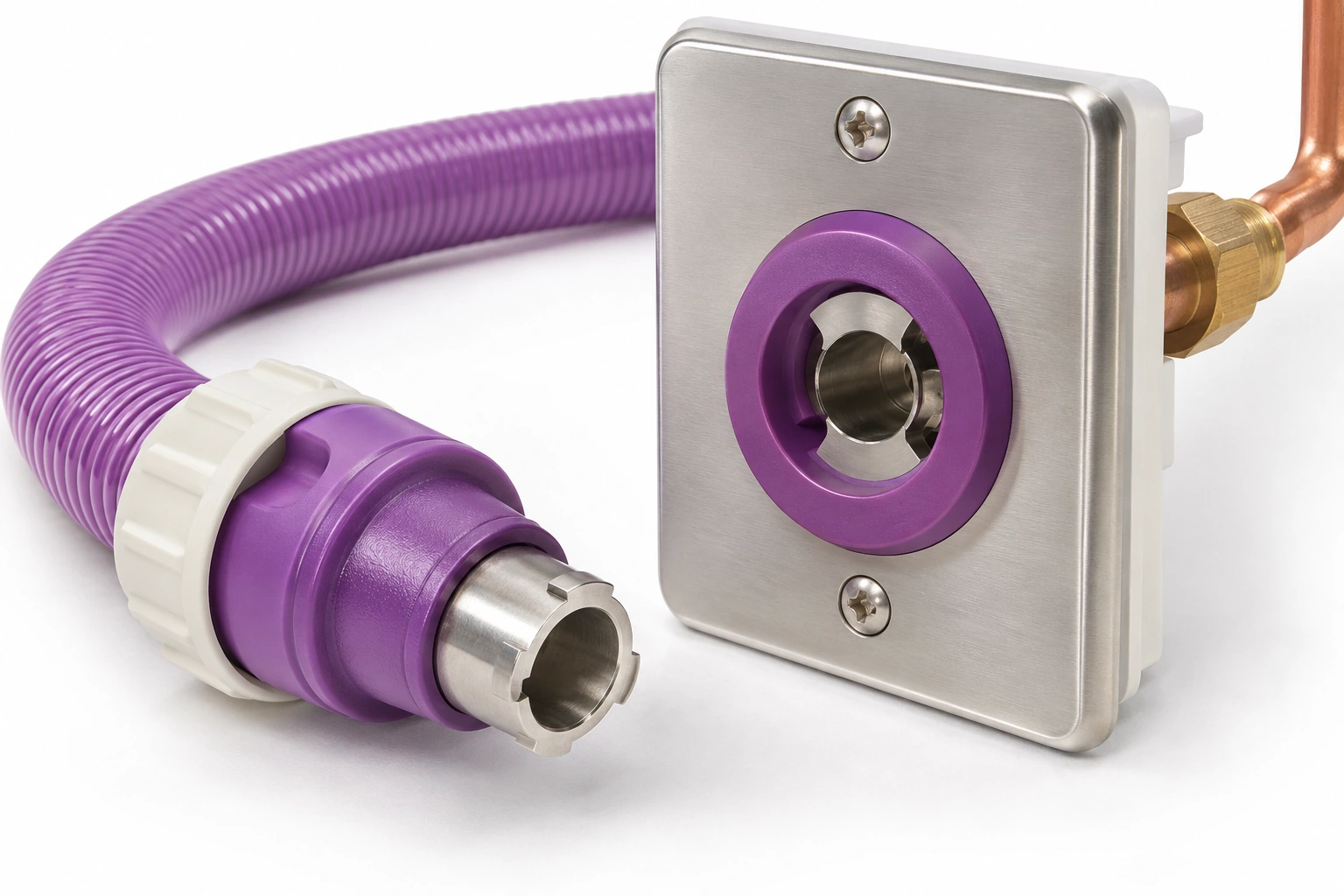
An operating theatre's anaesthetic gas scavenging arrangement is a chain of equipment, not a single suction outlet. Waste anaesthetic gases must be captured at the appropriate equipment connection, transferred through a protected receiving arrangement, matched to a correctly specified terminal and conveyed to an acceptable final disposal location. Procurement becomes difficult when separate vendors each describe their part as “the AGSS.”
The most useful deliverable is a machine-to-building interface register. It identifies exactly what the anaesthesia equipment vendor supplies, what the medical-gas contractor installs, what the disposal plant specialist proves and what the hospital must authorize. This is a project coordination guide, not an instruction for connecting equipment during patient care.
Start at the anaesthesia workstation boundary
ISO 80601-2-13:2022, together with its 2026 Amendment 1, addresses the anaesthetic workstation and applicable scavenging components. The equipment manufacturer defines its collection and transfer configuration, pressure protection, permitted hoses and performance conditions.
Obtain the exact workstation model and revision, receiving interface type, nominal and permissible waste-gas transfer conditions, warnings and manufacturer-approved external connection. Do not substitute a seemingly similar hose or bypass the machine's receiving system.
Identify the hospital disposal system separately
ISO 7396-2:2007 covers the dedicated anaesthetic gas scavenging disposal system: its power device, pipeline, performance, installation, testing and commissioning. The AGSS terminal connection is addressed by ISO 9170-2:2008.
This separation matters commercially. A compliant workstation does not certify the building piping; conversely, a functioning extraction plant does not establish that a particular machine's protected receiving system has been correctly integrated.
Five-boundary interface register
| Boundary | What must be identified | Responsible evidence |
|---|---|---|
| Waste-gas collection | Approved workstation collection port and intended capture conditions | Anaesthesia equipment manufacturer |
| Transfer path | Exact hose/assembly, flow and pressure limits | Machine/clinical equipment team |
| Receiving/protective interface | Patient-protection features and permitted disposal connection | Workstation manufacturer |
| AGSS terminal | Gas-scavenging-specific body and mating probe | Terminal/component supplier and installer |
| Disposal pipeline and power device | Dedicated route, duty, failure behavior and safe discharge | AGSS specialist designer/installer |
| Final discharge | Approved outdoor position and environmental obligations | Estates and building-services designer |
| Handover | Linked evidence for all connected parts | Hospital responsible authority |
A specification that merely says “AGSS connector supplied” is missing almost every interface needed for final acceptance.
Separate compatible appearance from approved function
A terminal probe can look broadly like a medical-gas connector while being intended for a different application. The non-interchangeability principle is central to ISO 9170-2 and the dedicated disposal-system requirements.
Do not use adapters to connect medical suction, oxygen or air terminals to AGSS equipment. A system interconnection that seems to extract gas may still compromise patient protection or occupational safety.
Consider failure of one part without blaming another
If theatre staff report inadequate gas removal, possible causes include anaesthesia equipment leaks, transfer components, incorrect terminal configuration, pipeline losses, extraction plant status and unsuitable discharge design. The installed-interface register identifies which qualified team owns each investigation.
[OSHA's waste anaesthetic gas guidance](https://www.osha.gov/waste-anesthetic-gases/workplace-exposures-guidelines) treats capture at source, correct scavenging and general ventilation as complementary controls. A working room ventilation system is not proof of correct AGSS equipment integration.
Example: a theatre that has a terminal but not a complete service
A renovation contractor installs a wall plate labelled “AGSS” and the anaesthesia supplier delivers a workstation with its own compatible-looking tubing. The equipment schedule does not state the terminal type or the building disposal performance at the operating point.
The hospital should defer acceptance of that interface until the correct mating connection, supported disposal operating conditions and authorized tests are documented. Neither supplier's generic catalogue photograph resolves the discrepancy.
Produce the construction and acceptance package
Request a coordinated drawing showing the equipment-side interface, terminal identification, pipeline route, power device location and discharge boundary. Link each to the relevant supplier model numbers and drawings, then establish an approved factory/site witness matrix.
The 2026 NHS England HTM 02-01 places design, validation and operational roles within a controlled healthcare engineering framework. The project-specific approval authority determines final commissioning scope.
BWC Medgas component relevance
BWC Medgas provides selected medical gas terminal and installation components to approved drawings; a particular AGSS terminal or probe must be confirmed by exact model before quotation. BWC does not represent itself as the manufacturer of a complete AGSS disposal plant.
Share the AGSS interface schedule with BWC Medgas.
Frequently asked questions
Is a terminal mounted on the wall enough to complete an AGSS system?
No. The workstation interface, compatible terminal, disposal path, powered performance and discharge must be verified together.
Can a medical vacuum outlet be used in place of a dedicated AGSS outlet?
No. A separate appropriately designed AGSS system and non-interchangeable interfaces are required by the intended design framework.
Primary technical references
- ISO 7396-2:2007 — AGSS disposal systems
- ISO 9170-2:2008 — AGSS terminal units
- ISO 80601-2-13:2022 — Anaesthetic workstations
- ISO 80601-2-13:2022/Amd 1:2026
- NHS England HTM 02-01 (2026)
- [OSHA — Workplace exposure to waste anaesthetic gases](https://www.osha.gov/waste-anesthetic-gases/workplace-exposures-guidelines)