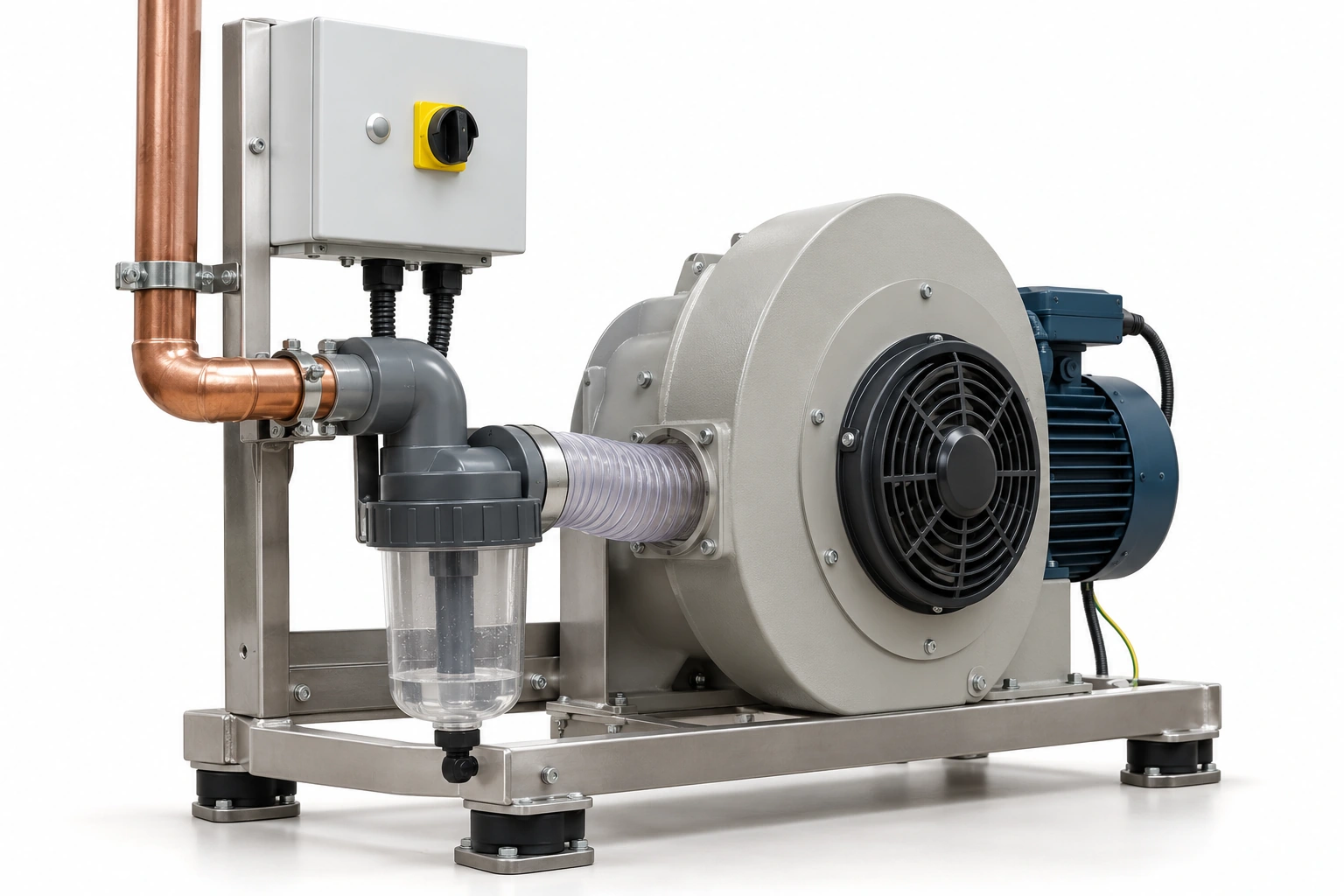
A central anaesthetic gas scavenging disposal system may serve several operating theatres and procedure rooms, each with its own anaesthesia workstation and local terminal. Choosing the extraction plant from the number of wall outlets alone can be just as misleading as choosing it from the number of pumps on a supplier's frame.
The project must define the required disposal performance across realistic simultaneous clinical activity, then verify that the power device, distribution pipework and terminal units remain within their approved operating limits.
Establish the actual served locations
Begin with an issued room-and-equipment schedule: theatre, pendant position, anaesthesia machine model, intended scavenging use, terminal type and the design authority's future provision. Include procedure rooms only where the hospital's approved anaesthetic services plan requires scavenging.
Do not assume every room is used continuously or that a universal diversity factor is acceptable. Simultaneous use and emergency conditions are decided by the healthcare design team, not inferred from general building occupancy.
The design input matrix
| Field | Site-specific input | Evidence needed |
|---|---|---|
| Rooms/terminals | Number and actual location of AGSS connection points | Clinical/architectural drawings |
| Workstation types | Exact anaesthesia machine and scavenging interface | Manufacturer IFU/data |
| Permitted flow envelope | Supported interface and receiving-system conditions | Workstation datasheets |
| Simultaneity | Approved operating scenarios and diversity | Clinical use plan |
| Distribution network | Route, branches, resistance and elevation where relevant | AGSS designer calculations |
| Power device | Effective duty under the system's operating conditions | Manufacturer performance curve |
| Standby/availability | Project resilience and maintenance strategy | Approved risk assessment |
| Discharge | Environmental routing and outlet conditions | Building-services design |
| Acceptance | Installed functional test cases and test points | Commissioning specification |
The table becomes the shared basis for technical comparison; a single catalogue flow number is not enough.
Distinguish free-air capacity from operating duty
The extraction plant supplier may quote an unrestricted fan or blower flow at a nominal condition, but the installed system has resistance through pipes, bends, terminals and any required control components. The effective flow across the required operating range is what matters.
ISO 7396-2:2007 addresses performance and testing of the disposal system, while ISO 9170-2:2008 concerns the terminal interface. Neither justifies treating a zero-resistance blower rating as verified delivery to every theatre.
Treat over-extraction as a design concern too
Scavenging is not necessarily improved by applying unlimited suction. The anaesthesia workstation's protected receiving/transfer arrangement must prevent unsafe effects on the patient breathing system and remain compatible with the connected disposal system.
ISO 80601-2-13:2022 provides the workstation safety boundary. The system designer needs to confirm both the low and high ends of permitted performance, not simply the largest possible extraction flow.
Example: unequal rooms, equal-looking outlets
A hospital proposes six identical AGSS terminals. Four will serve full operating theatres while two connect to specialist procedure spaces with different equipment interfaces and operating patterns. Two vendor quotes each state a six-outlet capacity, without identifying the workstation conditions or simultaneous-use case.
Return the room schedule to bidders and request capacity curves, network calculation assumptions, terminal model compatibility and acceptance points against the same scenario. The number six is not a technical design.
Resilience and service planning
The designer must explain whether duty/standby equipment is required, what happens if the normal extraction unit fails and how maintenance affects clinical operating-room availability. More than one fan does not automatically prove continuity if the electrical/control/discharge path is shared.
Clinical leadership should approve the service availability requirements and any operational contingencies. Do not instruct facilities personnel to test failure conditions by switching off a live AGSS during surgery.
Tie factory evidence to installed performance
A factory test may establish one power device's curve or assembly function. A site test must verify the commissioned arrangement, including actual terminal positions and the relevant receiving interfaces.
The NHS Scotland SHTM 02-01 (2026) lists Form A17 for AGSS tests, with project details and acceptance governed by the adopted local procedures. NHS England HTM 02-01 provides the broader current UK design and verification guidance.
Procurement checklist
Request a room schedule, workstation interface limits, rated terminal variants, complete plant duty curve, maximum installed operating envelope, noise/energy characteristics, standby and control concept, discharge design, commissioned test plan, spare-part availability and explicit exclusions.
BWC Medgas can quote selected terminal fittings and medical gas installation accessories when the AGSS interface and exact approved model are defined. Complete extraction-plant capacity calculations are the responsibility of the appointed specialist.
Send the approved AGSS terminal/interface requirement to BWC Medgas.
Frequently asked questions
Can a six-outlet AGSS always serve six simultaneous anaesthesia workstations?
Not without proving the required simultaneous-duty case and each workstation's permitted operating conditions.
Does a larger blower automatically make the system safer?
No. Excessive extraction and the anaesthesia workstation interface must also be assessed.