
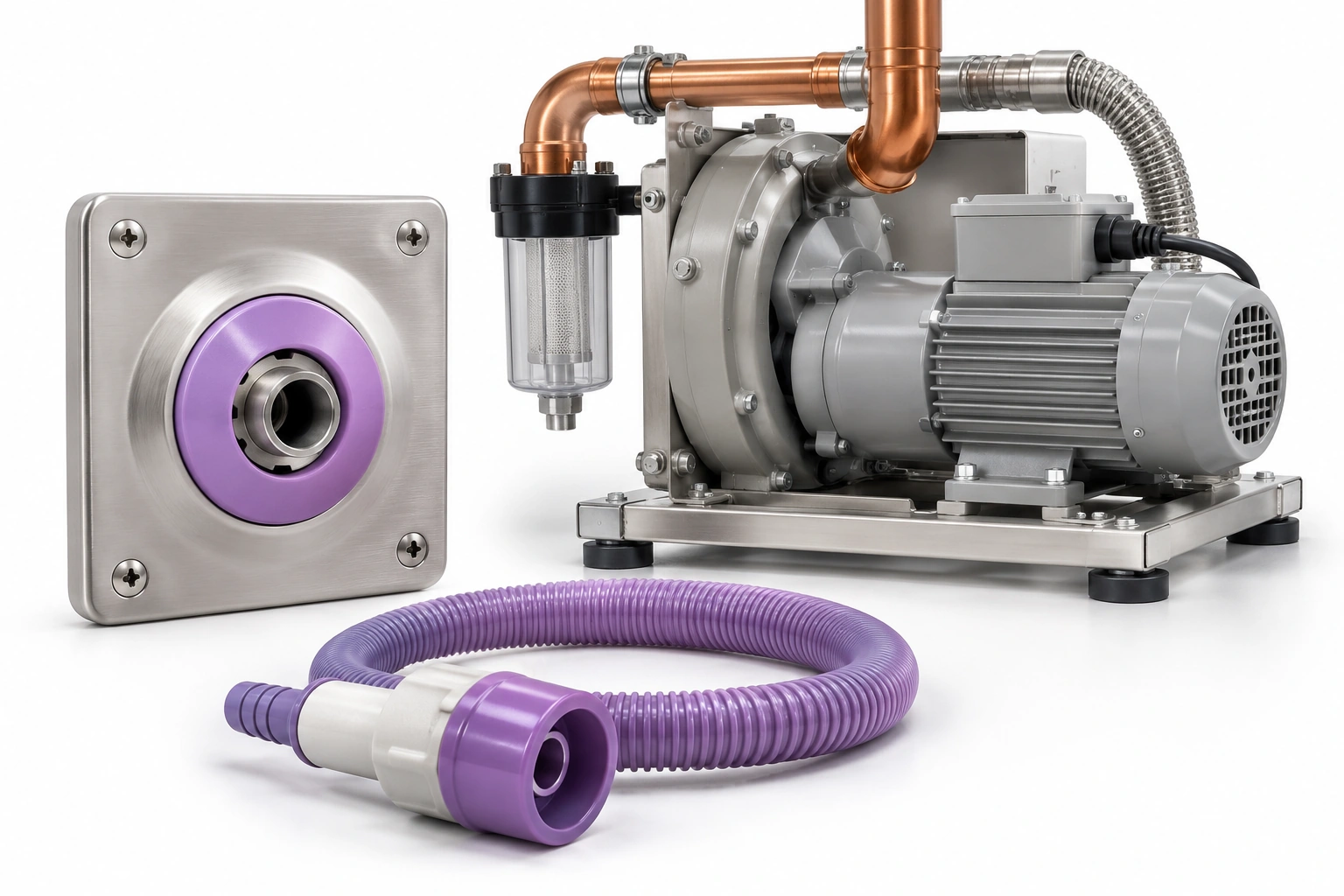
Hospital purchasing teams may receive three very different offers to a request headed “AGSS system”: one supplier quotes only the terminal units, another quotes a packaged extraction plant and a third quotes full disposal piping and commissioning. A single unit price cannot determine value when the scopes are not comparable.
A scope-normalized AGSS bid matrix separates exact technical eligibility from a complete delivered-cost evaluation. It also protects the hospital from assuming that a supplier of terminal components is responsible for the entire clinical disposal service.
Start with precise procurement lots
Define the tender as one or several controlled scopes: (1) AGSS outlet terminals and probes, (2) dedicated disposal power device and its controls, (3) pipeline and final discharge, (4) workstation interface coordination, (5) site verification and healthcare handover.
Each scope has a different product boundary and responsible party. ISO 9170-2:2008 addresses the terminal; ISO 7396-2:2007 the disposal system; and ISO 80601-2-13:2022 the anaesthetic equipment side.
Normalize the technical offers
| Required scope | Bidder A | Bidder B | Technical gate |
|---|---|---|---|
| Terminal type and probe | Exact model and counterpart | Exact model and counterpart | Non-interchangeability |
| Workstation interface | Included or coordinated | Included or coordinated | Approved manufacturer fit |
| Number of rooms | Actual schedule | Actual schedule | Full site coverage |
| Installed duty | Curve and operating scenario | Curve and operating scenario | Flow/pressure envelope |
| Source continuity | Defined plant availability | Defined plant availability | Risk-based resilience |
| Alarm/monitoring | Point and receiver matrix | Point and receiver matrix | Site functional acceptance |
| Discharge route | Materials and termination scope | Materials and termination scope | Building/environmental approval |
| Tests/handover | FAT, A17/site, operator evidence | FAT, A17/site, operator evidence | Controlled commissioning |
| Spares/warranty | Models, lead time and support | Models, lead time and support | Lifecycle maintainability |
A line left blank should be treated as an unanswered requirement, not presumed inclusion.
Keep the standards current
ISO 7396-2:2007 and ISO 9170-2:2008 remain published as of November 2026. Older workstation scavenging transfer/receiving standards may appear in archived tenders; confirm the currently applicable ISO 80601-2-13 and adopted national implementation.
The 2026 SHTM 02-01 lists AGSS site test Form A17. A Scottish form is useful reference material, but a tender for another jurisdiction must specify the locally adopted testing and regulatory requirements.
Example of a false low bid
Illustrative arithmetic only, not market prices: Supplier A quotes USD 1,100 for ten AGSS terminal units, but excludes ten compatible probes at USD 28 each and ten specified backing/mounting kits at USD 16 each. The like-for-like terminal equipment subtotal is USD 1,540 before freight, installation, taxes and tests.
Supplier B quotes USD 1,475 inclusive for the same technically approved terminal scope. This makes B's normalized equipment quote lower by USD 65, but both still need engineering compliance and model compatibility checks before an award.
Compare actual installed cost and energy
For a full disposal plant, compare useful operating flow over the accepted duty cases, measured energy at the actual load profile, noise, service access, maintenance intervals, replacement power-device modules, controls, sensors and expected part lead times.
A larger nominal blower rating does not automatically mean a better or safer system. Costs should use the hospital's real operating hours, electricity tariff, site labor and manufacturer servicing assumptions.
Clarify the environmental scope
A plant that moves waste gas is not necessarily a complete disposal installation. Discharge location, potential air-intake re-entrainment, construction routing and workplace exposure management require their own approved design and work programmes.
[OSHA's occupational waste-gas guidance](https://www.osha.gov/waste-anesthetic-gases/workplace-exposures-guidelines) shows why scavenging, ventilation, leak control and monitoring are complementary. Tender exclusions must not make these responsibilities disappear.
Document commercial and handover acceptance
The purchase order should state exact model/revision, quantities, included probes and kits, source/duty assumptions, deliverables, packaging, export/regulatory terms, installation scope, factory tests, local site tests, operating manuals, training, warranty, spare-part support and accepted deviations.
The 2026 NHS England HTM 02-01 reinforces the distinction between product delivery and authorized installed-system verification and operation.
BWC Medgas component offer
BWC Medgas can quote selected medical gas outlets, fittings and installation accessories where the exact AGSS component specification and availability are confirmed. It does not price itself as the manufacturer of complete AGSS power/disposal plants.
Send your approved AGSS terminal or component RFQ to BWC Medgas.
Frequently asked questions
Is a low-priced “AGSS outlet” necessarily a complete terminal-and-probe assembly?
No. Confirm the exact included component list and correct type.
Can one equipment certificate replace an installed AGSS site commissioning dossier?
No. Device, network, extraction plant and clinical handover evidence have distinct boundaries.
Primary technical references
- ISO 7396-2:2007 — Disposal system specification
- ISO 9170-2:2008 — Terminal and probe
- ISO 80601-2-13:2022 — Workstation
- NHS Scotland SHTM 02-01 (2026)
- NHS England HTM 02-01 (2026)
- [OSHA — Waste anaesthetic gas workplace guidance](https://www.osha.gov/waste-anesthetic-gases/workplace-exposures-guidelines)