AGSS failures can be difficult to identify because the problem might be located at the anaesthesia equipment, transfer hose, terminal unit, extraction plant, distribution pipework or final discharge. In an older hospital, undocumented renovations increase the risk that equipment or piping does not match the approved drawings.
A fault-and-service identity register protects against vague repair orders, unapproved substitutions and the dangerous idea that “any available suction connection will work.” This is a reporting and engineering management framework; it does not instruct anyone to open or reroute a live medical-gas system.
Preserve the separate system identity
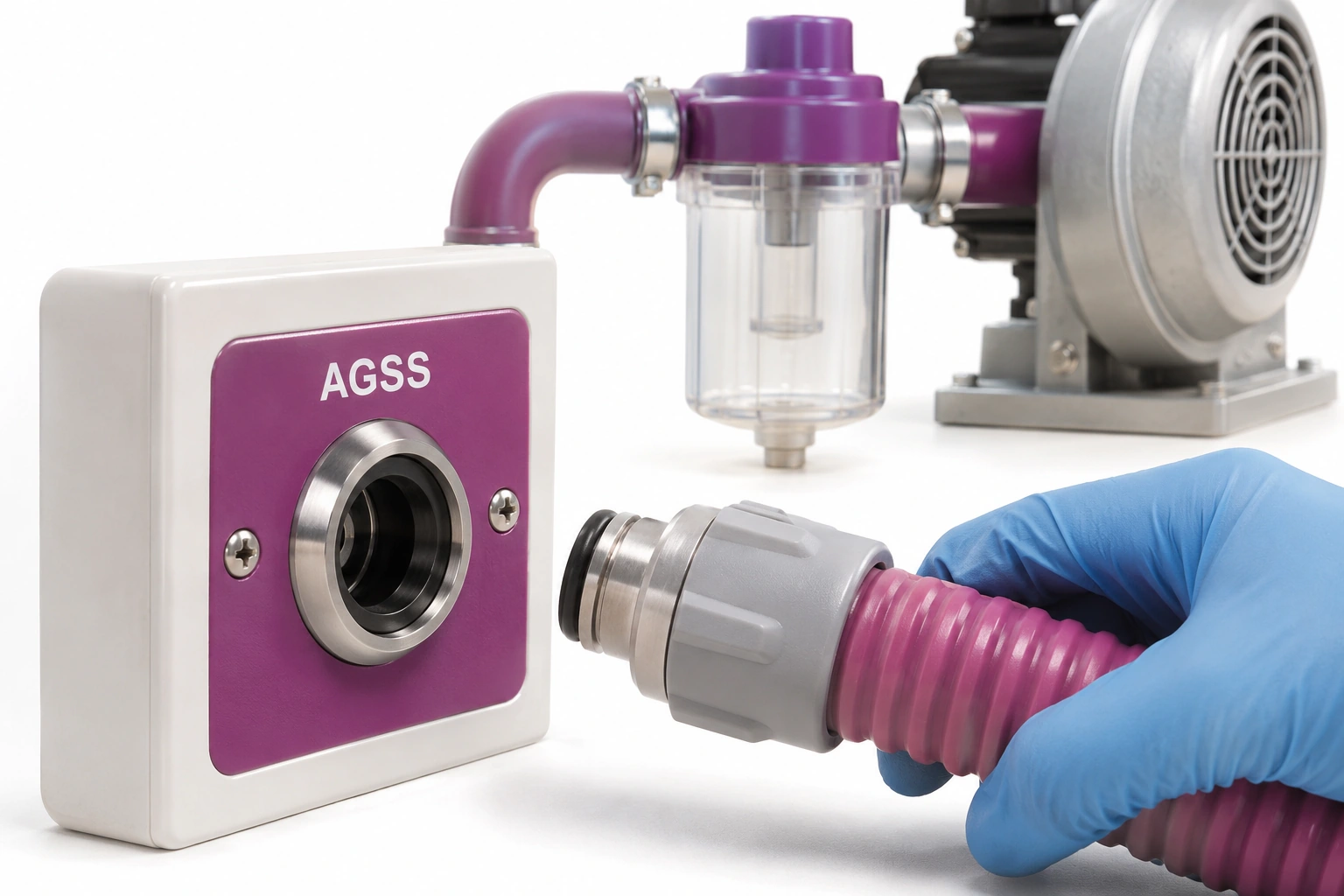
ISO 7396-2:2007 stresses non-interchangeability and avoidance of cross-connections between AGSS disposal systems and medical gas/vacuum pipelines. ISO 9170-2:2008 adds requirements for type-specific AGSS terminal units and their mating counterparts.
Record the full service identity at the room, wall terminal, pendant interface and plant. Correct identification must be maintained when an operating room is renovated or a workstation is replaced.
Trace the fault to a physical boundary
| Fault register field | Required record | Reason |
|---|---|---|
| Reporter/time | Exact room and observed symptom | Reproducible context |
| Equipment state | Workstation and connected interface model | Separates machine and plant |
| Terminal identity | Type/model, location, accepted connection | Avoids false substitutions |
| Distribution route | Approved branch and as-built changes | Network traceability |
| Plant condition | Named power device, controller and known status | Source assessment |
| Airflow/pressure basis | Measurement and method if authorized | Meaningful technical comparison |
| Staff exposure | Occupational safety concern and escalation | Proper safety ownership |
| Work authorization | Competent party and clinical permit scope | Protects in-use services |
| Closure | Accepted repair and relevant retest | Audit trail |
No item in this table should be completed from a guess based on a photograph.
Different symptoms suggest different evidence needs
A disconnected transfer hose or improperly matched workstation interface requires a device-level check using manufacturer instructions. A poorly performing terminal or distribution route requires an AGSS specialist's installed-system review. An extraction plant alarm requires its own controls and performance assessment.
The correct objective is to identify which boundary needs expert attention, not to offer a field troubleshooting sequence that could disturb patient care.
Why “it still sucks” is insufficient
An outlet's apparent ability to draw in air says little about the correct connection family, specified performance across load cases or patient protection at the anaesthesia workstation.
ISO 80601-2-13:2022 covers the workstation and relevant scavenging parts. The installation's allowed operating envelope must match the manufacturer's accepted interface requirements.
Example: a renovation changes more than the outlet cover
An older operating theatre receives a new pendant and AGSS-labelled faceplate. The installer reuses an existing connection behind the ceiling without presenting its as-built identity or test record.
The responsible engineering team should not release the service until the distribution route, terminal type, non-interchangeability and approved functional verification are demonstrated. A new cover with matching colour does not establish that the source is correct.
Protect hospital exposure management
[OSHA's workplace exposure guidance](https://www.osha.gov/waste-anesthetic-gases/workplace-exposures-guidelines) addresses waste-gas leakage, routine machine maintenance, ventilation and staff exposure investigation. If personnel report exposure concerns, involve occupational safety and clinical governance even when the AGSS controls show no fault.
Do not equate a repair ticket's closure with documented exposure reduction unless appropriate follow-up evidence exists.
Changes and spare-part control
A replacement terminal, probe, seal, fitting or hose must match the relevant manufacturer-approved assembly and gas-service identity. Record its model/lot, installer, reason for substitution and relevant verification.
Never specify a generic adapter to bridge incompatible AGSS, medical vacuum or respiratory connections. Unsupported shortcuts can defeat the designed non-interchangeability safeguards.
Safe acceptance after intervention
Plan permitted tests with the correct clinicians and competent engineering personnel. In the UK, SHTM 02-01 (2026) provides a specific AGSS A17 test boundary; the actual scope of retesting depends on the modified element and approved site procedures.
Maintain the original defect, repair evidence, affected points, witness records and formal restoration approval. Do not overwrite the initial failure report.
BWC Medgas procurement relevance
BWC Medgas can quote specified medical-gas terminal, outlet and installation components subject to exact approved model compatibility. This is different from accepting responsibility for clinical fault diagnosis or complete AGSS disposal plant maintenance.
Request an exact replacement-interface quotation from BWC Medgas.
Frequently asked questions
Can a nominally matching outlet cover prove that an AGSS pipe is correctly connected?
No. As-built identity and qualified functional tests are required.
Is a visible airflow indication sufficient evidence of a compliant AGSS terminal?
No. The system type, mating connection and performance requirements must be verified.
Primary technical references
- ISO 7396-2:2007 — AGSS cross-connection prevention
- ISO 9170-2:2008 — Terminal non-interchangeability
- ISO 80601-2-13:2022 — Anaesthesia equipment interface
- [OSHA — Waste anaesthetic gas workplace guidance](https://www.osha.gov/waste-anesthetic-gases/workplace-exposures-guidelines)
- NHS Scotland SHTM 02-01 (2026), A17