An AGSS disposal plant has a simple environmental purpose—remove waste anaesthetic gas from occupied clinical spaces—but its connection to an anaesthetic workstation cannot be treated as a general exhaust hose. Conditions applied at the receiving interface can affect the upstream breathing-system safety architecture if the connection or protection is wrong.
The procurement team needs a protected-interface handover checklist that separates patient-side workstation requirements from the building-level disposal performance. This guide does not describe adjustments to anaesthesia machinery during patient care.
Define the interface using the workstation's instructions
ISO 80601-2-13:2022 applies to an anaesthetic workstation and relevant scavenging components; its 2026 Amendment 1 includes changes relevant to the connections between parts of transfer and receiving systems.
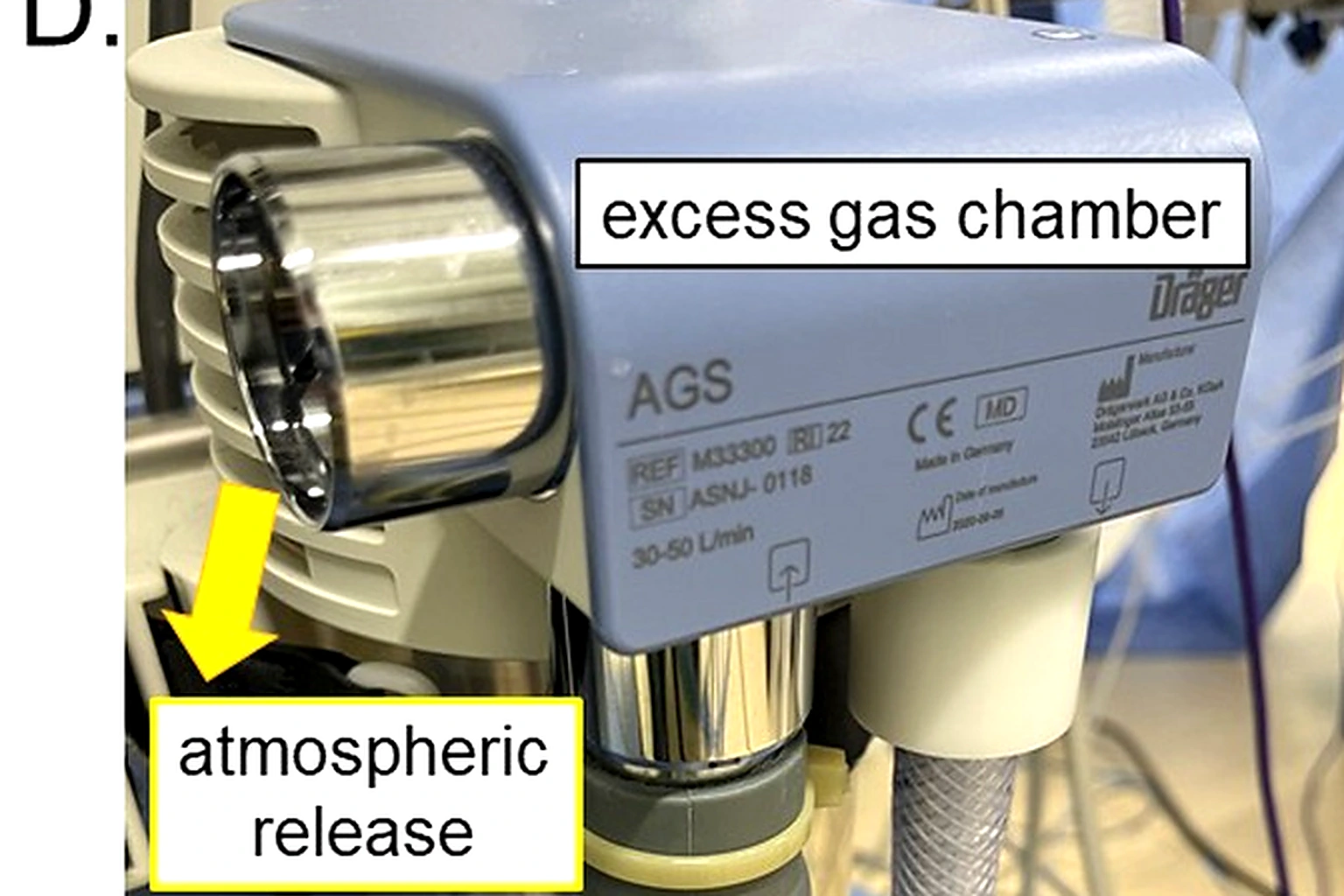
Obtain the manufacturer-approved arrangement showing how waste gas passes from the anaesthesia breathing system into the receiving/scavenging side. Document all approved accessories and the limits of permissible external conditions.
Do not assume that a receiving reservoir or relief component is optional simply because a different machine model incorporates it within a housing.
Why pressure protection matters
A properly designed receiving arrangement protects the patient breathing system from undesirable effects of scavenging disposal pressure. Excessive negative pressure, obstruction or unintended positive pressure must be handled according to the equipment's design and applicable standard.
[OSHA's workplace exposure guidance](https://www.osha.gov/waste-anesthetic-gases/workplace-exposures-guidelines) identifies the interface as a part of the scavenging chain with pressure-protective functions. The same text distinguishes active and passive removal and emphasizes capture at source combined with appropriate operating practice.
Avoid general advice such as “more suction is always better.” Such advice conflates occupational waste-gas capture with patient safety.
Commissioning interface matrix
| Engineering field | Record and approve | Owner |
|---|---|---|
| Workstation model | Exact approved unit and firmware/configuration where relevant | Biomedical team |
| Collection source | Manufacturer waste-gas outlet/collection arrangement | Anaesthesia equipment vendor |
| Transfer assembly | Correct hose, length limits and connection family | Manufacturer/biomedical |
| Receiving protection | Built-in or separate protective elements and IFU | Manufacturer |
| Disposal-side connector | Matching AGSS probe and terminal | MGPS/AGSS installer |
| External operating range | Approved supply/disposal performance envelope | Workstation and AGSS designers |
| Failure handling | Obstruction, loss of extraction or excessive pressure response | Risk assessment |
| Clinical acceptance | Equipment commissioning and staff instruction | Hospital clinical/biomedical |
A specification should not leave the relationship between equipment vendor and hospital engineering implicit.
Identify manufacturer responsibilities at the purchase order
The anaesthesia equipment supplier should state exactly which transfer and receiving parts are included and which the hospital must procure. The AGSS installer should state the exact expected terminal and supported disposal conditions.
If a vendor supplies only a “scavenging kit” with ambiguous ends, request the full model-specific bill of materials and connection diagram. This avoids discovering during site acceptance that two nominally complete contracts fail to meet at the same interface.
Example: pressure is measured at the wrong point
An AGSS contractor demonstrates the extraction plant at its mechanical-room discharge branch; an anaesthesia vendor then reports that the workstation's receiving system performs abnormally when connected.
The two observations are not contradictory. The plant test has not established the actual terminal conditions or the workstation's protective interface requirements. A joined engineering test plan is needed; arbitrary adjustments to the patient-side equipment are inappropriate.
Do not confuse collection with dilution ventilation
The [OSHA guidance](https://www.osha.gov/waste-anesthetic-gases/workplace-exposures-guidelines) distinguishes source capture through the scavenging system from general room ventilation that dilutes remaining leaks or emissions. Acceptable room ventilation does not prove the machine-side scavenging connection is present or functioning.
Conversely, a successful AGSS connection does not eliminate the need for appropriate theatre ventilation, maintenance and exposure-control practices.
Link standards and clinical approvals
ISO 7396-2:2007 governs the disposal system and ISO 9170-2:2008 its terminal. Their requirements are complementary to, not replacements for, the workstation standard.
Site acceptance should retain exact unit IDs, manufacturer connection instructions, permitted operating range, observed tests, defects/retests, clinical handover and relevant staff training.
Where BWC contributes
BWC Medgas supplies selected medical gas connectors, terminal and related installation parts to approved drawings and actual product availability, not patient breathing-system design or complete AGSS plant installation.
Send the exact workstation–AGSS connection schedule to BWC Medgas.
Frequently asked questions
Can a stronger extraction fan improve every anaesthesia workstation connection?
No. The receiving interface and its permitted external pressure/flow limits must also be respected.
Is workplace ventilation a substitute for correctly connected scavenging?
No. Source capture and room dilution are separate exposure controls.
Primary technical references
- ISO 80601-2-13:2022 — Anaesthetic workstation
- ISO 80601-2-13:2022/Amd 1:2026
- ISO 7396-2:2007 — AGSS disposal system
- ISO 9170-2:2008 — Terminal unit
- [OSHA — Waste anaesthetic gas workplace controls](https://www.osha.gov/waste-anesthetic-gases/workplace-exposures-guidelines)