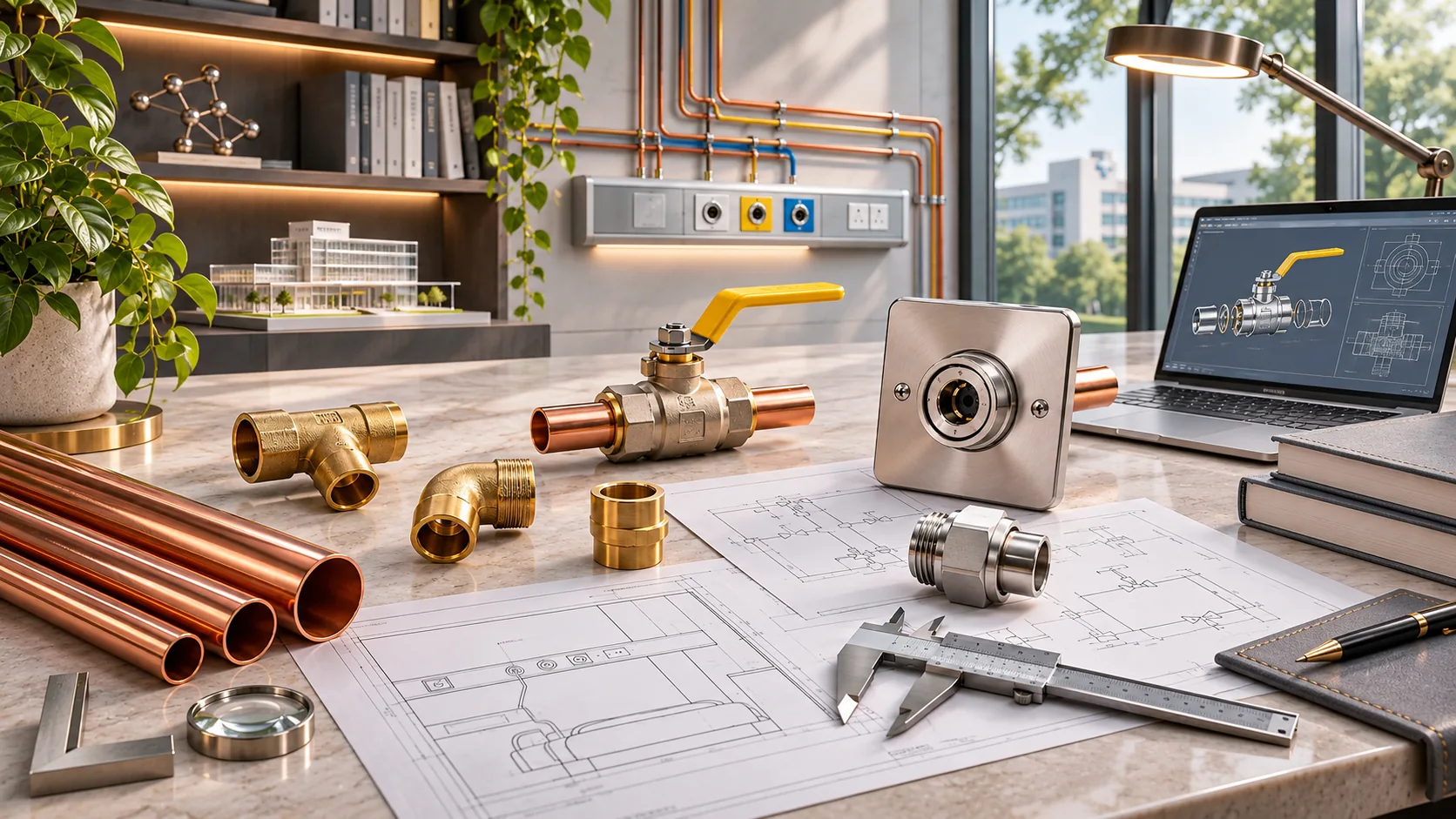
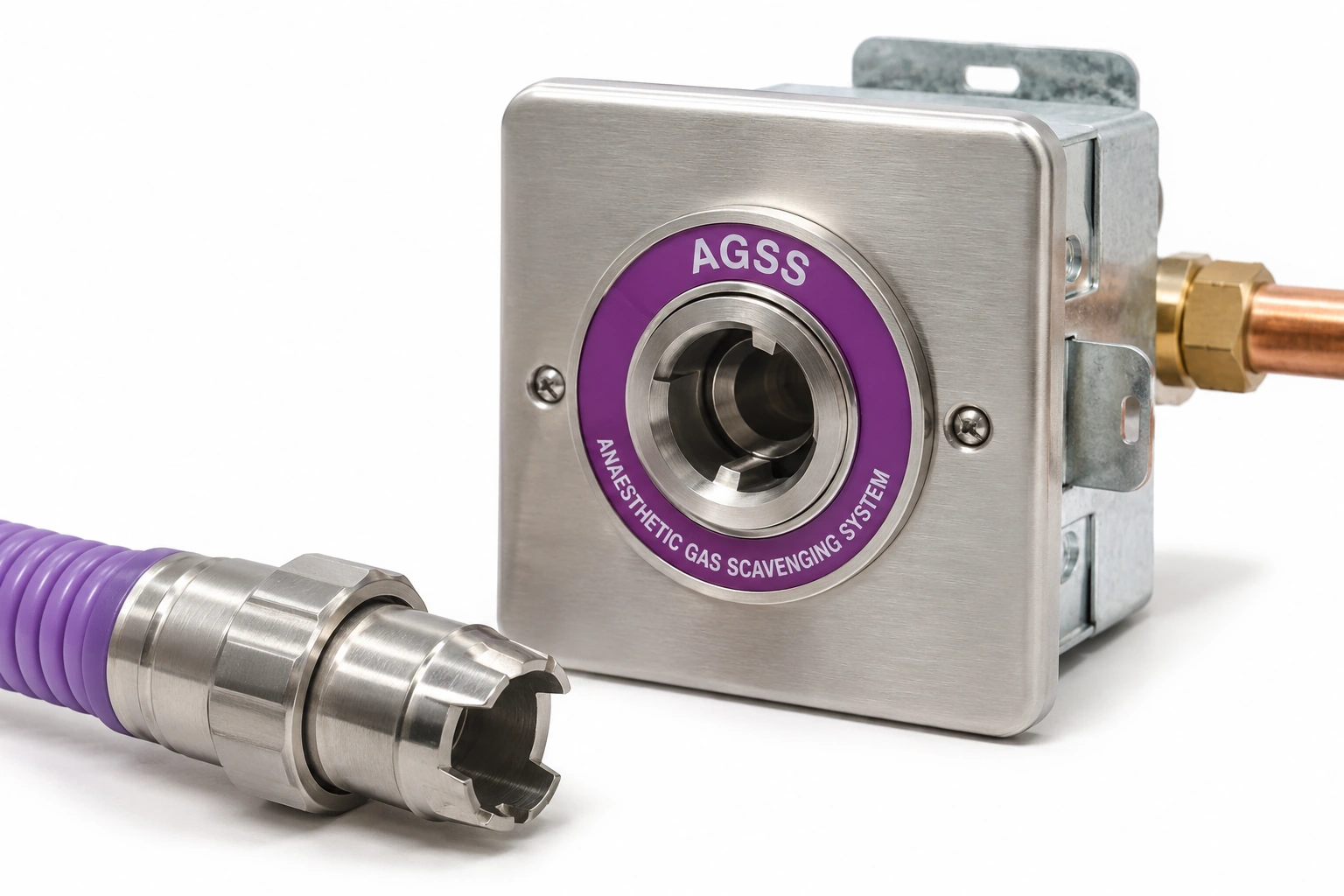
An anaesthetic gas scavenging terminal is a safety-critical interface between the hospital disposal infrastructure and the anaesthesia equipment. It may be built into a wall faceplate, pendant or other approved supply location, and different terminal technologies can look strikingly similar in marketing photographs.
The procurement job is to order a specific functional and mating interface, not a generic purple-ring outlet. This article builds a model-level specification and replacement audit without providing instructions to adapt or connect live devices.
Confirm the terminal's intended system type
ISO 9170-2:2008 addresses AGSS terminal units and their type-specific mating probes. It distinguishes terminal arrangements according to the power device's position relative to the terminal.
The buyer must obtain the project-approved type and the exact compatible probe design. The existing site's configuration and applicable regional requirements determine the correct choice; do not infer system type from a photograph or assume all nominal AGSS faceplates are interchangeable.
Match the back and front interfaces
The visible front port is only one part of the component. The installed assembly may also include a mounting box, copper tail or other pipe connection, check/isolating features and required fittings as specified by the manufacturer.
For a replacement job, document both the patient-equipment-facing probe interface and the building-disposal-facing connection, including space constraints and model revisions. A plug that appears to fit does not establish the necessary function.
The terminal and probe purchase schedule
| Required field | What the supplier must identify | Why it matters |
|---|---|---|
| AGSS type | Exact type and applicable power-device arrangement | Functional compatibility |
| Full model/revision | Manufacturer reference and service configuration | Traceable substitution |
| Faceplate and service label | Approved AGSS identification | Avoid cross-service confusion |
| Mating probe | Exact manufacturer-approved counterpart | Non-interchangeability |
| Rear fitting | Connection drawing and supported pipe arrangement | Correct installation scope |
| Mounting | Wall/pendant/back box and service accessibility | Site fit |
| Operating conditions | Intended flow/pressure range and stated test basis | Safety and performance |
| Servicing | Approved disassembly/inspection parts and IFU | Lifecycle maintenance |
| Verification | Model tests and actual installed functional test | Acceptance boundary |
“Compatible with medical gas” is not a technically sufficient connection description.
Acknowledge the wider separation requirement
ISO 7396-2:2007 requires the disposal system to avoid cross-connections with medical gas and vacuum pipeline systems. This is why a similar shape or the presence of suction is not permission to connect AGSS devices to hospital medical vacuum outlets.
Document the physical and labeling controls that preserve gas/service specificity. If an old building contains a non-standard connector, seek qualified engineering redesign instead of specifying an adapter by intuition.
Example: old terminal and new anaesthesia machine
A facility replaces its anaesthesia workstations but retains the AGSS wall units. The equipment vendor's new scavenging hose has a connector from another range, and the nursing team asks purchasing to buy an inexpensive converter.
The correct sequence is a formal interface review: identify the original terminal type, the new machine's receiving arrangement, the specific approved probe and the disposal-system operating envelope. Any redesign must be accepted before purchasing.
Protect the workstation side
ISO 80601-2-13:2022 covers the anaesthetic workstation safety and its scavenging components. A correct terminal alone does not prove that the machine-side interface offers the required pressure protections or that its flow is suitable.
The vendor should supply the approved connection and instructions rather than just a photograph of an AGSS probe.
Receiving and installation QA
At delivery, check the purchase order against the exact model and revision, included probe, service markings, approved packaging, damage, instructions and inspection records. The installation contractor should preserve the correct pipe/service identity through the construction process.
The Scottish 2026 SHTM 02-01 includes AGSS test form A17, and the English HTM 02-01 (2026) addresses the wider project validation framework. Supplier item tests and completed site verification are different evidence.
BWC Medgas component coordination
BWC Medgas can assist with selected medical-gas terminal components subject to exact approved AGSS model and interface availability; catalogue similarity is not a basis for promising compatibility.
Submit terminal and probe drawings to BWC Medgas.
Frequently asked questions
Can all purple or AGSS-labelled outlet ports accept the same probe?
No. Type, model and country-specific connection geometry must be confirmed.
Does the terminal manufacturer's product certificate approve the completed AGSS disposal network?
No. Installed-system verification is a separate project requirement.