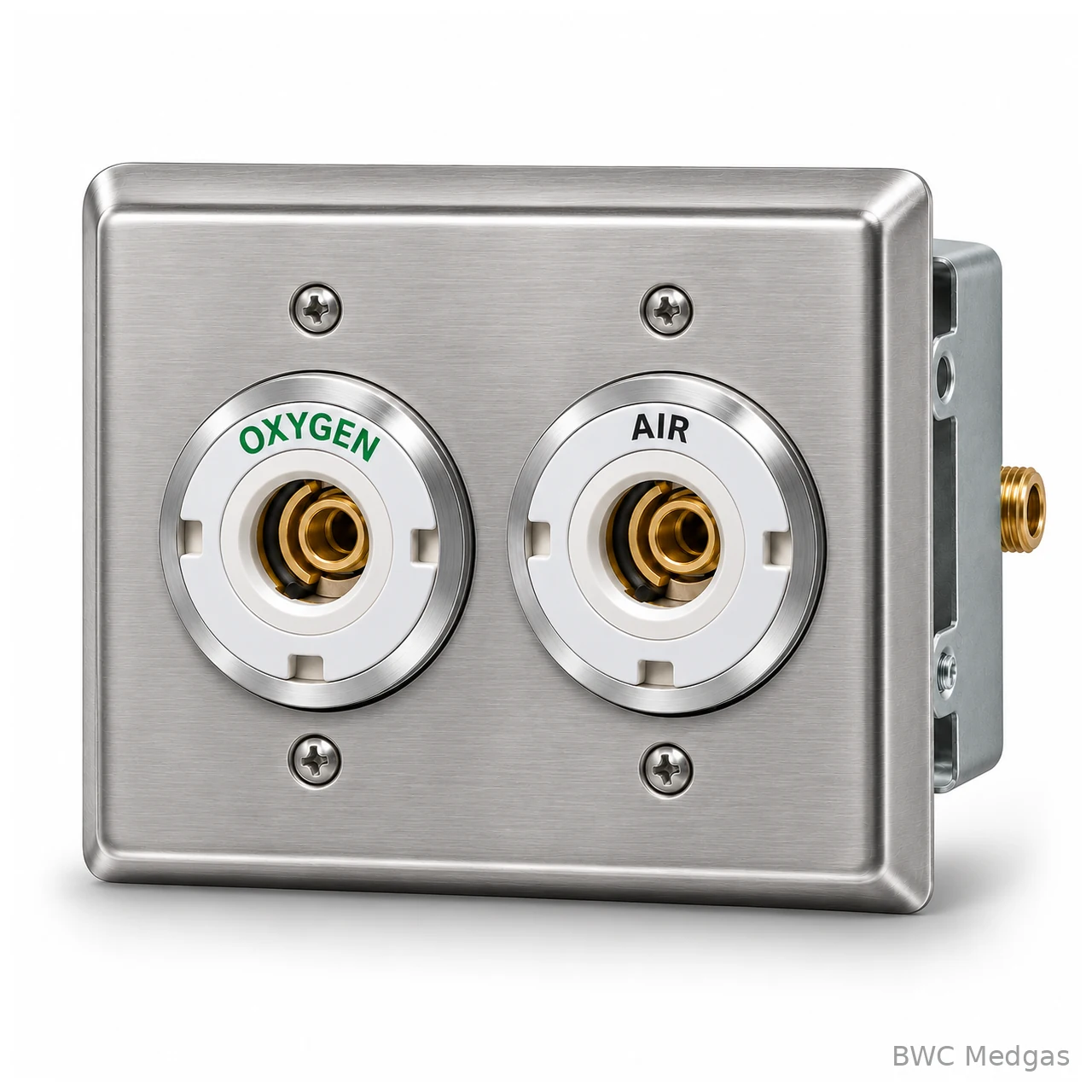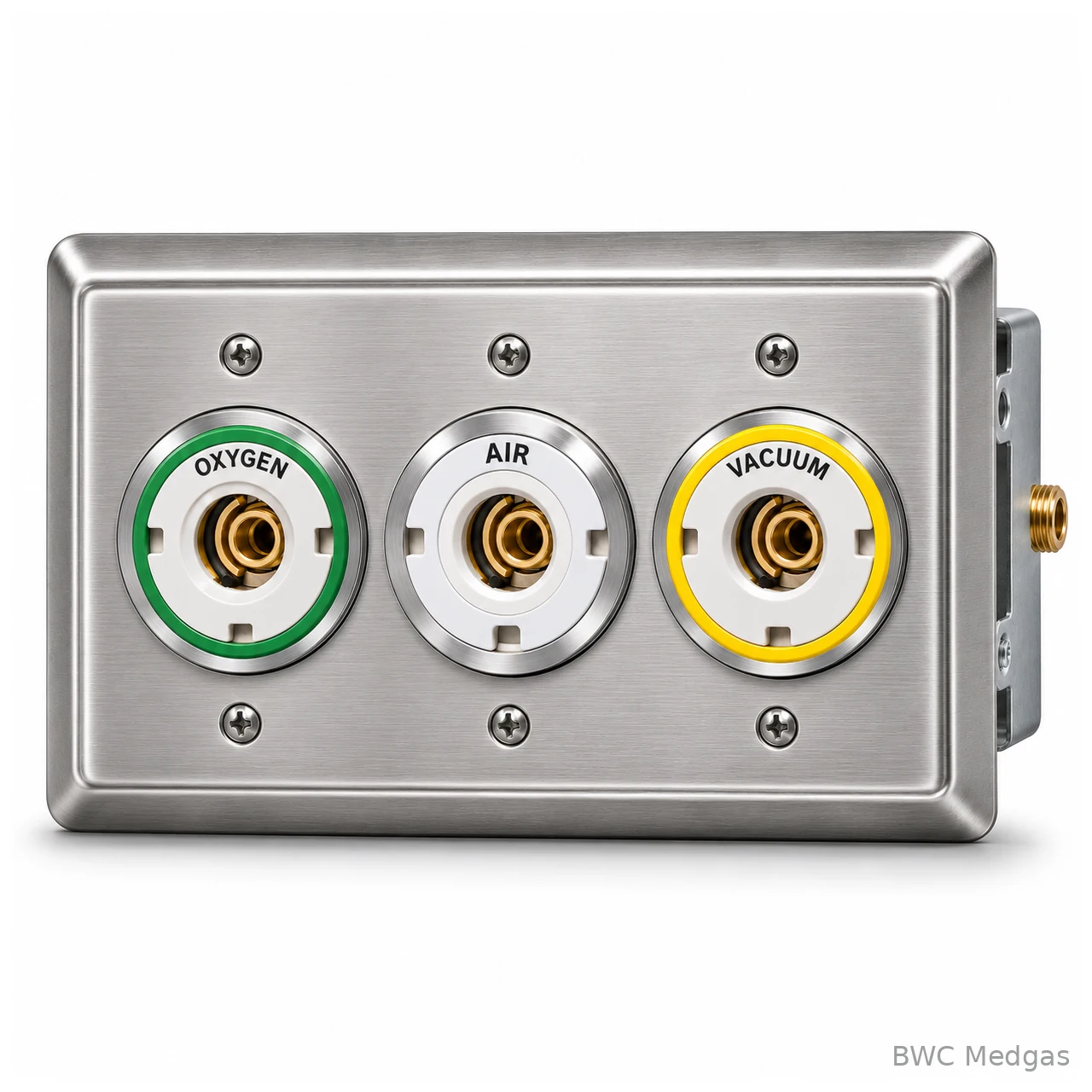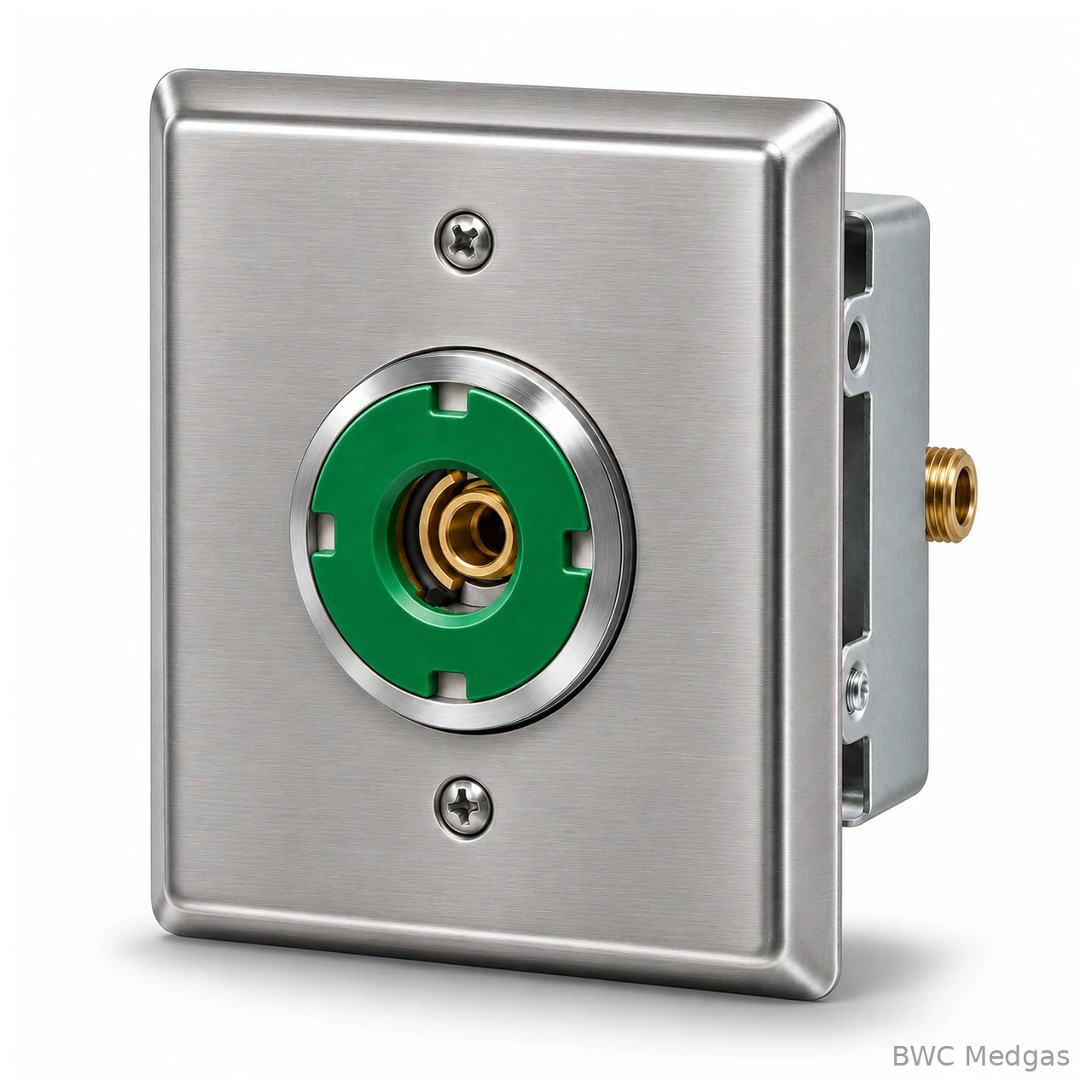

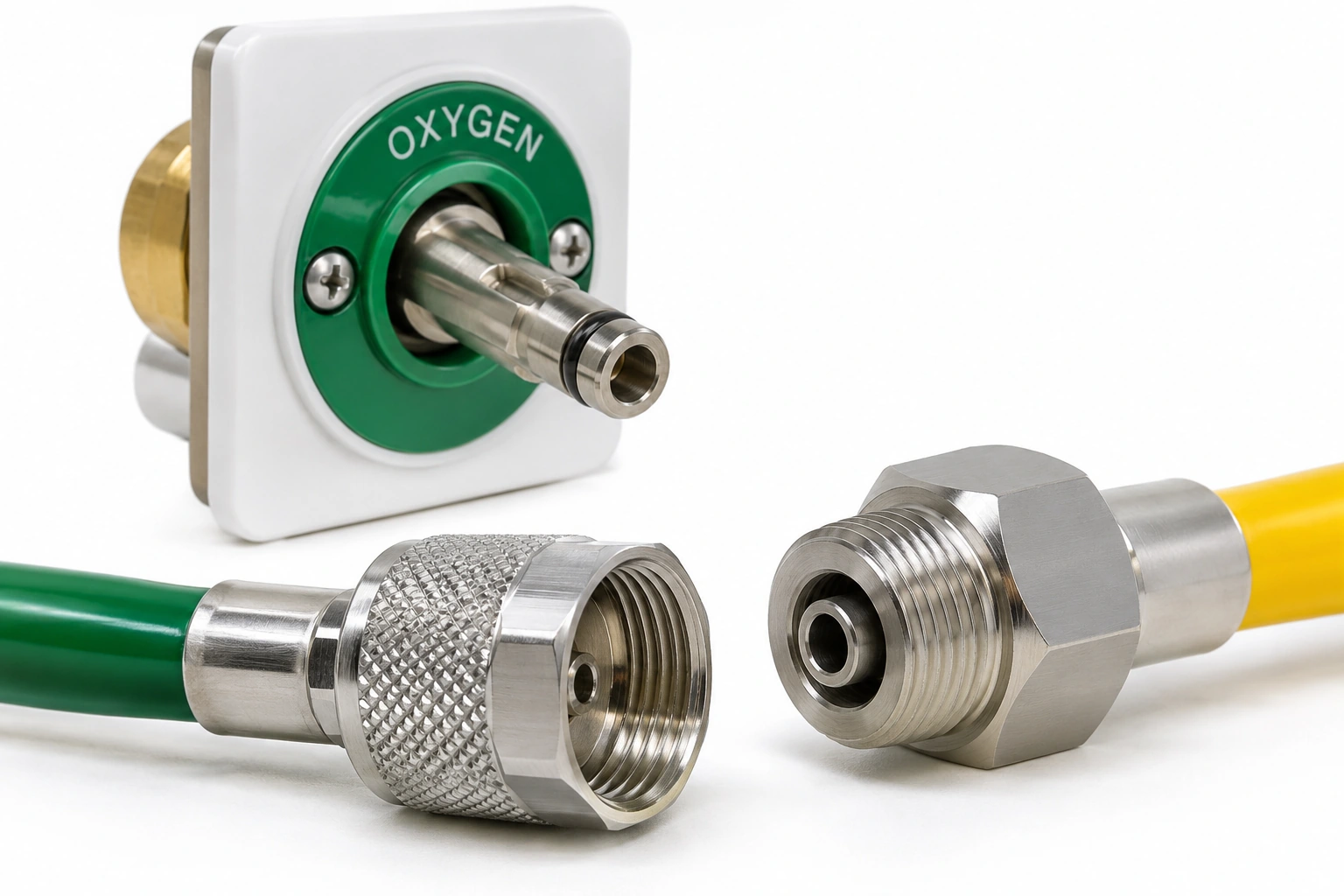
DISS and NIST appear regularly on medical gas equipment lists, particularly on hoses, valves, pressure accessories and some pipeline-related interfaces. A purchase order may simply say “oxygen NIST connector” or “DISS adapter.” Yet a connection family name is not a complete technical drawing, and it cannot establish whether a specific pair of components will mate correctly.
For international MGPS sourcing, the practical goal is to preserve the gas-specific connection defined by the approved design while identifying the actual interface of every purchased component.
What do DISS and NIST mean in medical gas terminology?
The publicly viewable definitions in ISO 7396-1:2016 give examples of gas-specific connectors. These include diameter-indexed safety system (DISS), non-interchangeable screw-threaded (NIST), sleeve-indexed system (SIS), quick connectors and other screw-threaded connectors.
The underlying concept is that the dimensions or other design features of the connector prevent an unintended connection between different gas services. A name such as DISS or NIST therefore identifies a *connector family or principle*—not every individual dimension, service assignment or mating accessory.
ISO 7396-1 is concerned with the medical gas and vacuum pipeline system. It does not grant permission to replace the project's exact connection requirements with a generic item marked “universal.”
Are medical gas terminal probes the same thing as NIST or DISS connectors?
Not necessarily. A terminal unit is the point at which an operator makes a connection to the intended medical gas or vacuum service. ISO 7396-1's terminology expressly recognises terminal units as one class of point-of-use component.
ISO 9170-1:2017 covers terminal units used for compressed medical gases and vacuum, and includes requirements related to gas specificity, leakage, pressure drop and probes. Its published abstract explicitly states that the document does not specify the dimensions of all terminal probes or gas-specific connection points; these may be defined by regional or national documents.
A connector used on the rear of a valve enclosure, a flexible hose end and a wall outlet probe are different places in the equipment system. They should not be conflated because a supplier's catalogue uses similar gas-specific terminology.
Why is the exact gas and connection function essential?
A drawing should identify the intended gas service and the function of the connection. A connector's physical dimensions, mating arrangement, thread details where applicable, and specified product standard must all match the approved equipment design.
For example, an enquiry for a medical oxygen valve accessory might involve a different interface from a patient-facing oxygen terminal. Calling both “oxygen connectors” is not enough to define the required item.
The NHS Scotland SHTM 02-01 (2026) lists separate verification forms for AVSU NIST connections, line-valve NIST connections, pendant NIST connections and gas-specific terminal units. This is particularly useful evidence that several connection-related subjects are treated separately in an installed medical gas system.
Those form titles are not themselves a connector dimensions catalogue.
What should a professional purchasing request include?
An effective request for NIST, DISS or terminal connectors should contain:
- The full name of the gas or vacuum service.
- The equipment duty: outlet, probe, hose-end connector, line-valve fitting, pressure accessory or other defined connection.
- The precise interface type, including both mating components where possible.
- A dimensioned manufacturer or approved project drawing, not merely a photograph.
- The applicable publication, national connector specification and edition specified by the project.
- Material requirements, included seals or accessories and quantities.
- Whether the existing installed component will be retained or replaced.
This prevents an international buyer from assuming that one region's version of an item can automatically replace another region's equipment.
When can photographs help?
Photographs help establish an initial identification, especially for spare parts or retrofit work. They are not sufficient evidence for final compatibility.
Where a contractor is replacing a terminal, a photograph of the mating probe and the original technical model information may be more useful than a front-plate photograph alone. For a threaded connection, the approved dimensional drawing is essential.
Relevant BWC Medgas components
BWC Medgas supplies medical gas terminal units, medical gas valves, zone valve boxes, manifold components and related installation accessories.
For a precise component enquiry, send BWC the gas service, connector family, relevant interface drawing and required quantities. BWC can discuss the actual component configuration, without claiming that every product with a similar visual connection is interchangeable.
Discuss a medical gas connector requirement with BWC Medgas.
Questions buyers commonly ask
Does a DISS or NIST label prove that two connectors fit together?
No. The specific gas-service connection and applicable mating dimensions must be confirmed from the relevant technical documentation.
Does ISO 9170-1 define a single connector for every country?
No. The international standard explicitly acknowledges that dimensional specifications for some connectors are defined in national or regional standards.