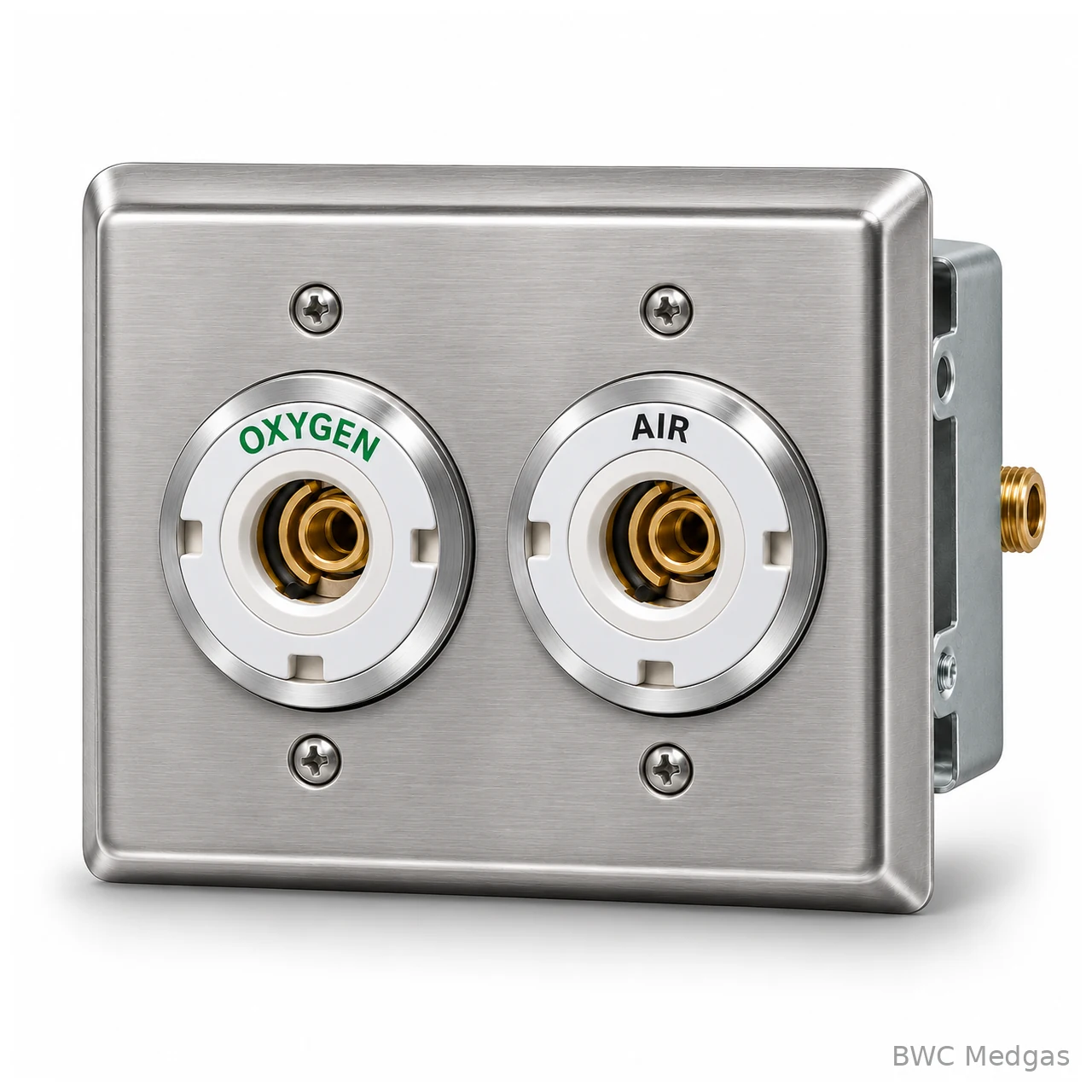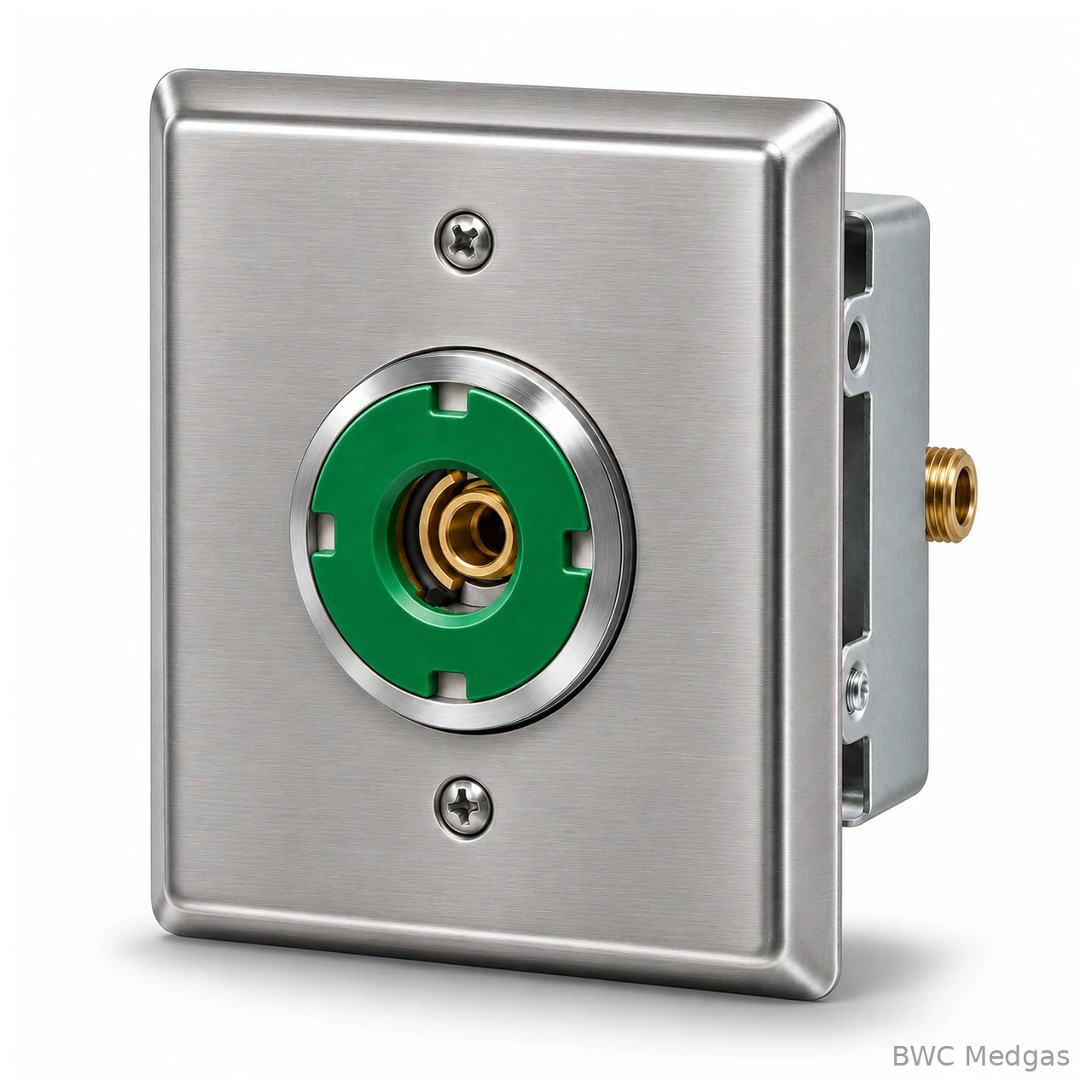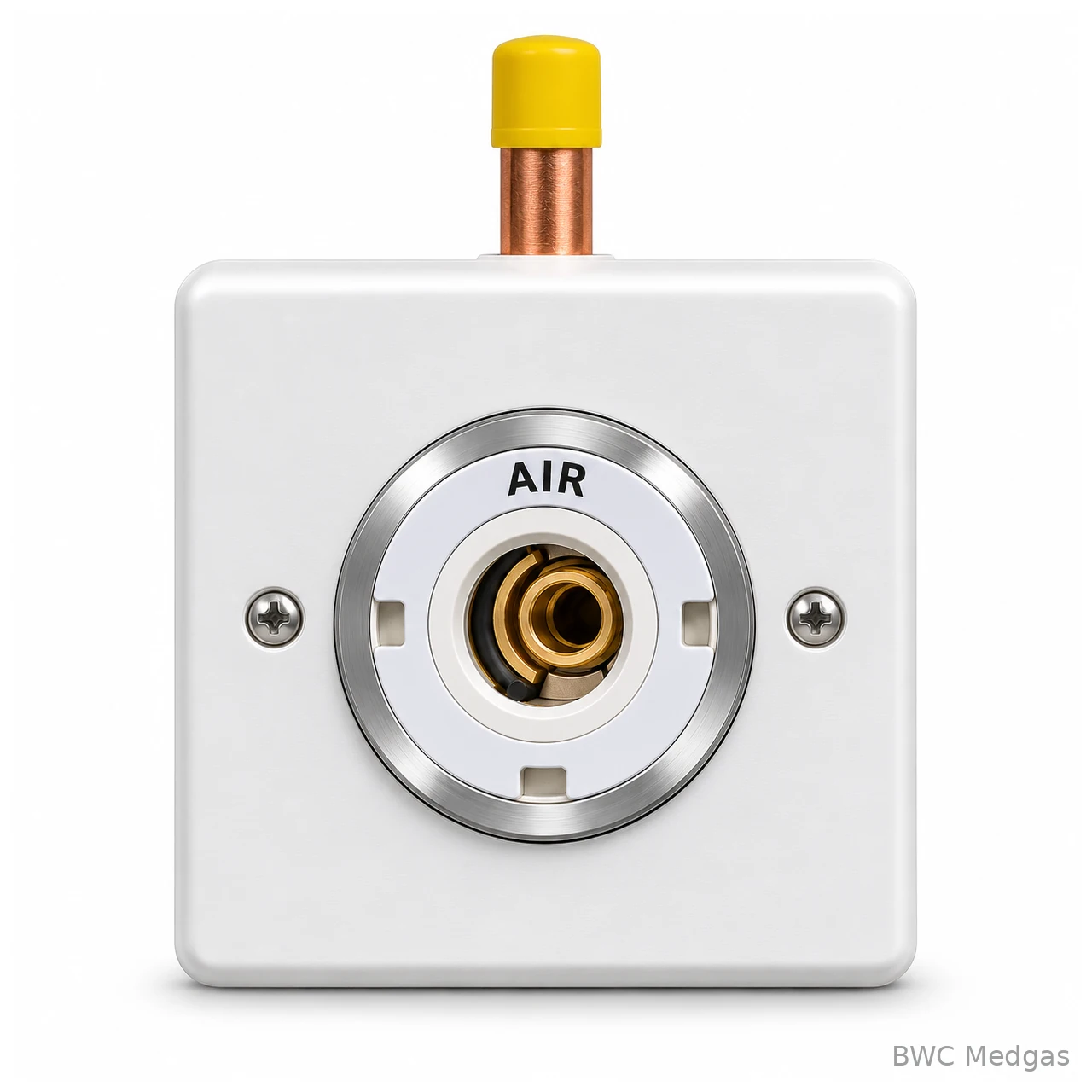
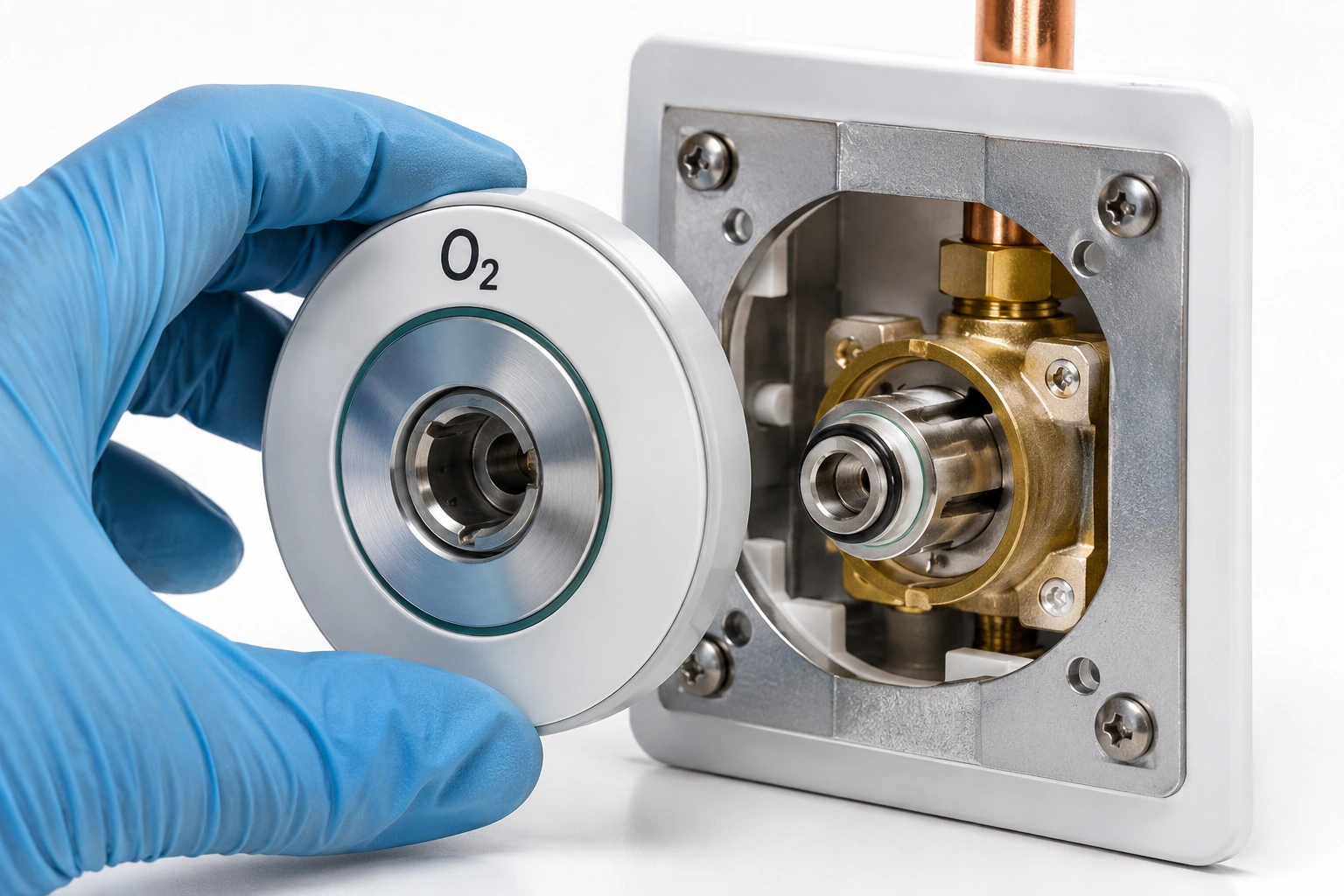
A patient-care area may report that an oxygen probe does not latch reliably, that a vacuum connection feels loose or that a wall outlet is damaged. The problem is not solved by ordering a random faceplate with the same gas label. The hospital needs a controlled terminal defect and maintenance process that traces the exact installed product, the observed condition and the qualified return-to-service decision.
This guide concerns asset information and escalation rather than do-it-yourself repair. Medical gas terminal interventions can affect patient care; work must follow the healthcare operator's approved medical gas management procedures.
Identify the terminal before assigning a repair
A useful work order should include the unique outlet ID, building/room/bed location, intended gas/vacuum service, manufacturer, exact model/variant, installed connection family, installation date if known and the relevant supply zone.
The visible front ring may have been replaced during an earlier refurbishment, so the face alone may not be sufficient to identify the full installed mechanism. Obtain verified component details, drawings and maintenance history.
Do not ask a general facilities worker to confirm component interchangeability by trial-fitting a different gas probe.
Capture symptoms as observations, not diagnoses
An operator report may mention difficulty connecting an approved probe, intermittent retention, visible damage, unusual mechanical action, a suspected leak or an absent label. Record the observed behavior in plain language and the context in which it was reported.
Do not assume a failure is a spring, O-ring or valve cartridge problem without competent inspection. A repeated complaint may reflect a mating probe or attached equipment rather than the wall terminal. The decision should examine the whole approved interface.
Avoid prescribing specific servicing steps or isolation operations in a public checklist.
The minimum work-order evidence fields
| Field | Example of acceptable record |
|---|---|
| Asset and location | TU-ICU-03/O2; verified room position |
| Service and connection | Approved oxygen / national family / exact model |
| Reporter and observation | Time, reported issue and device used |
| Operational impact | Escalated under hospital clinical/estates process |
| Assigned competent person | Authorized role and permit reference |
| Inspection and disposition | Findings, approved action, parts and references |
| Re-verification | Applicable test/functional record IDs |
| Return-to-service approval | Designated healthcare authority and date |
The record should protect traceability, not become a public instruction for making an unsafe repair.
Control spare modules and replacement seals
An outlet product family can contain different service-specific inserts, valve elements and front modules. Even two devices sharing the same external plate may not have the same internal parts.
Maintain an approved spare parts register showing manufacturer product code, intended gas service, compatible host assembly, revision, procurement source and supporting evidence. Reject “universal” substitute descriptions unless compatibility is formally established by the appropriate manufacturer and hospital authority.
A different module can alter gas-specificity, mechanical performance or the ability to connect the intended medical device.
Set maintenance frequency through approved instructions
Do not claim every medical gas terminal must be serviced every six months or after a fixed number of connections. The hospital should use applicable statutory requirements, the adopted HTM 02-01 (2026) or equivalent, manufacturer instructions, operating experience and its assessed risk.
The asset management system can schedule accepted inspections and track overdue work. The maintenance planner should distinguish planned checks from urgent defect escalation and from site testing required after an intervention.
Analyse recurring failures
If multiple outlets of one model show similar documented problems, review the pattern by manufacturer, batch, location, age, connection family and intensity of use. A data trend can justify supplier consultation or wider competent investigation.
An observed trend is not proof of a manufacturing defect. Check affected components, handling, mating equipment and the quality of prior work. Keep the evidence so a corrective action can be evaluated later.
Coordinate work in occupied clinical areas
A repair or replacement may affect gas availability, room access and clinical workflows. The healthcare operator is responsible for designating who approves the work, what communications and contingency arrangements apply, and how the equipment is verified before release.
Create separate milestones for defect reported, risk reviewed, work authorized, intervention completed, required verification passed, and clinical service restored. These should not be overwritten with a single “ticket closed” timestamp.
Example: repeated failure to connect
A hospital reports three failures to engage a specific approved oxygen probe at the same outlet. The initial register shows a faceplate image but no module model or documented post-replacement test. The correct work order asks a qualified person to identify the component and exact mating device, assess the problem under site procedures and retain any required repair/test records.
The procurement team should not send a mixed set of probe adapters and expect bedside staff to experiment with fit.
Reference framework
ISO 9170-1:2017 addresses medical gas terminal unit assembly, mechanical resistance, leakage, flow, pressure drop and gas-specificity. ISO 7396-1:2016 covers the installed system and verification. The Scottish SHTM 02-01 (2026) provides operational guidance and terminal-level test forms.
BWC Medgas component support
BWC can discuss replacement medical gas terminal assemblies and related model-specific accessories where exact installed configuration data and required quantities are available. Hospital maintenance, repair authorization and clinical release are not delegated to a component seller.
Send the approved asset and replacement schedule to BWC Medgas.
Frequently asked questions
Can a leaking outlet be repaired by installing any same-size seal?
No. The manufacturer-approved service-specific part and competent maintenance procedure must be established.
Does closing a work order prove the outlet is ready for use?
No. Required verification and the healthcare operator's release decision remain separate.