
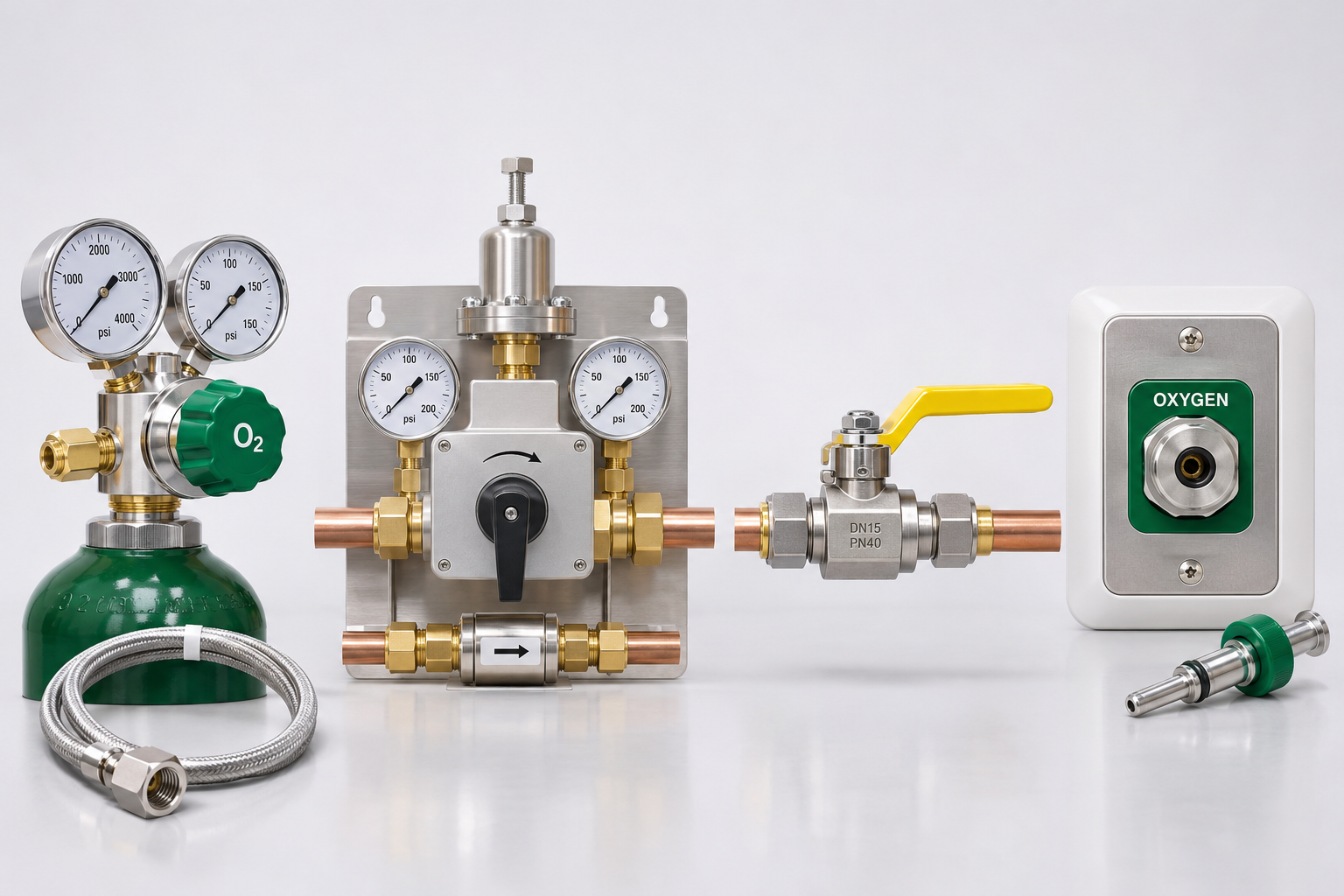
Regulators that look almost identical in a quotation can belong to different places in a medical-gas supply chain. The critical question is not simply “what is the outlet pressure?” It is where the device is installed, its incoming pressure envelope, gas service and intended regulated function.
The ISO 10524 series separates these applications. Using the wrong part of the series in an RFQ obscures the evidence that the hospital actually needs.
Which ISO 10524 part applies?
| Part | Defined area of use | Typical procurement decision |
|---|---|---|
| ISO 10524-1:2018 | Cylinder-mounted pressure regulators and regulators with flow-metering devices, including certain integrated medical equipment | Portable oxygen cylinder regulator |
| ISO 10524-2:2018 | Manifold and pipeline line regulators for medical-gas systems | Central manifold-stage or downstream line regulator |
| ISO 10524-3:2019 | Cylinder valves integrated with regulators (VIPRs) | Integrated medical cylinder valve/regulator package |
| ISO 10524-4:2008 | Low-pressure regulators connected to medical pipeline terminal units or other defined low-pressure outlets | Ward-level, terminal-fed regulator |
This is a *scope guide*, not a substitute for checking the precise clauses, intended use, design pressure and local approval route. ISO 10524-1 also has a published 2023 amendment; document the edition and amendment in the specification.
Why inlet pressure is not enough
A line regulator and a cylinder regulator may be offered with similar outlet pressure values, but their upstream gas source and safety function differ. Record maximum/minimum inlet conditions, flow demand, outlet range, relief arrangements, gas compatibility, connection design, markings, assembly location and serviceability.
A regulator offered for vacuum piping should not be assumed to fall under ISO 10524-2. Its official scope excludes vacuum pipeline pressure regulators. Check the appropriate vacuum application documents separately.
A regulator acceptance worksheet
| Evidence | Question the hospital should be able to answer |
|---|---|
| Model and part reference | Which ISO 10524 part is cited and why does it match this location? |
| Interface drawing | Are the cylinder, manifold or terminal connection details correct? |
| Design envelope | Are inlet, delivery pressure, flow and operating conditions documented? |
| Test evidence | Are functional and type-test results traceable to the exact model or family? |
| Oxygen service | Does the materials and cleanliness evidence match the intended gas? |
| Repair | Are replacement kits, seals and maintenance instructions controlled? |
| Site witness | Which plant function must be demonstrated after installation? |
Practical example: oxygen manifolds
A hospital requests spare first-stage regulators for an existing oxygen manifold and receives a catalogue page for a compact bedside regulator. Both may reduce pressure, but they are not interchangeable by function or installation context. Review ISO 10524-2 for the manifold/line application and reject any substitution without matching upstream pressure, safety features, connection and specified tests.
The tender should distinguish an individually supplied regulator from a complete automatic changeover assembly. The latter has system-level integration and alarm requirements beyond the component alone.
For manifold components and regulators and gauges, BWC Medgas can respond against an approved technical schedule. Include the regulator's intended position in the gas supply system; do not rely on a generic “medical regulator” description.