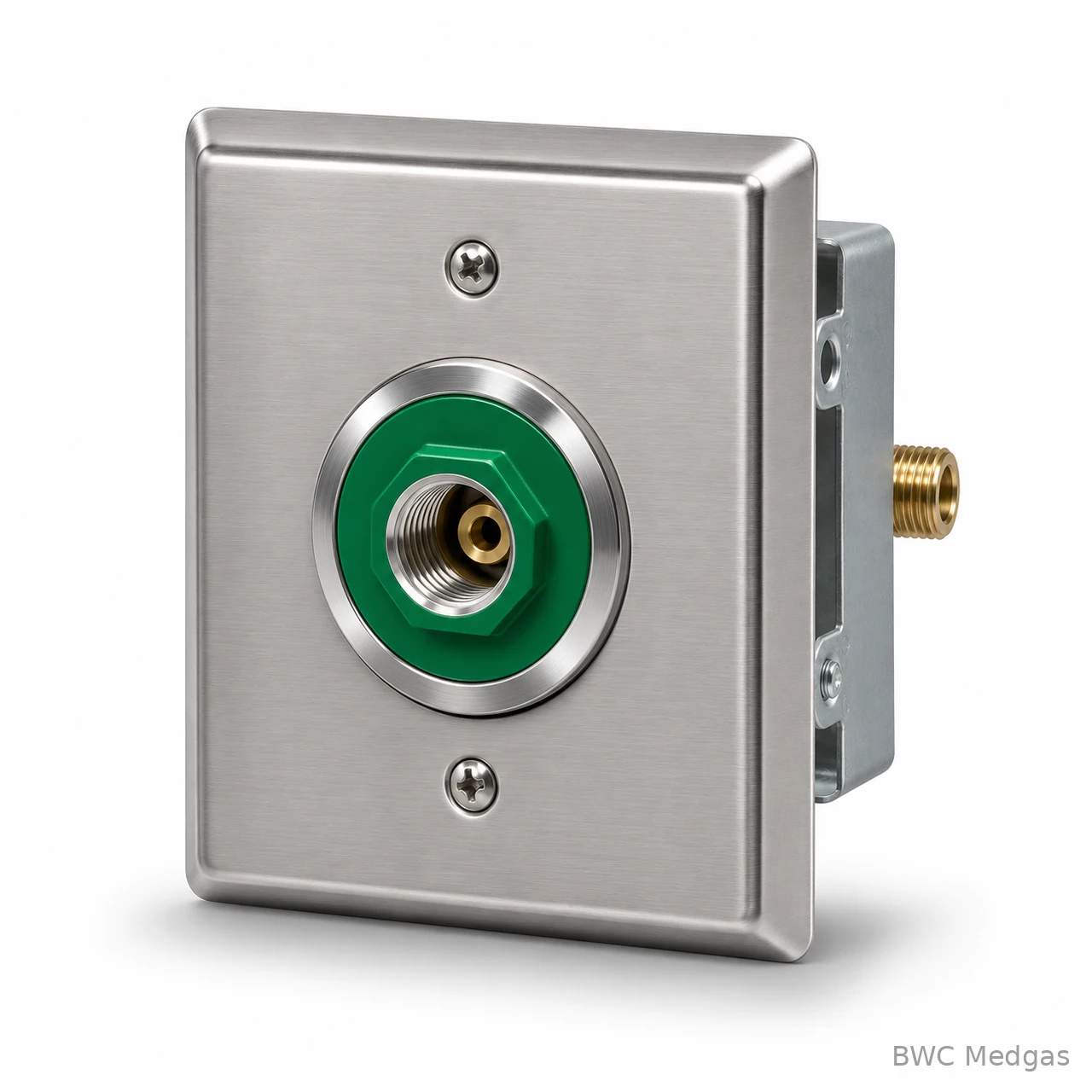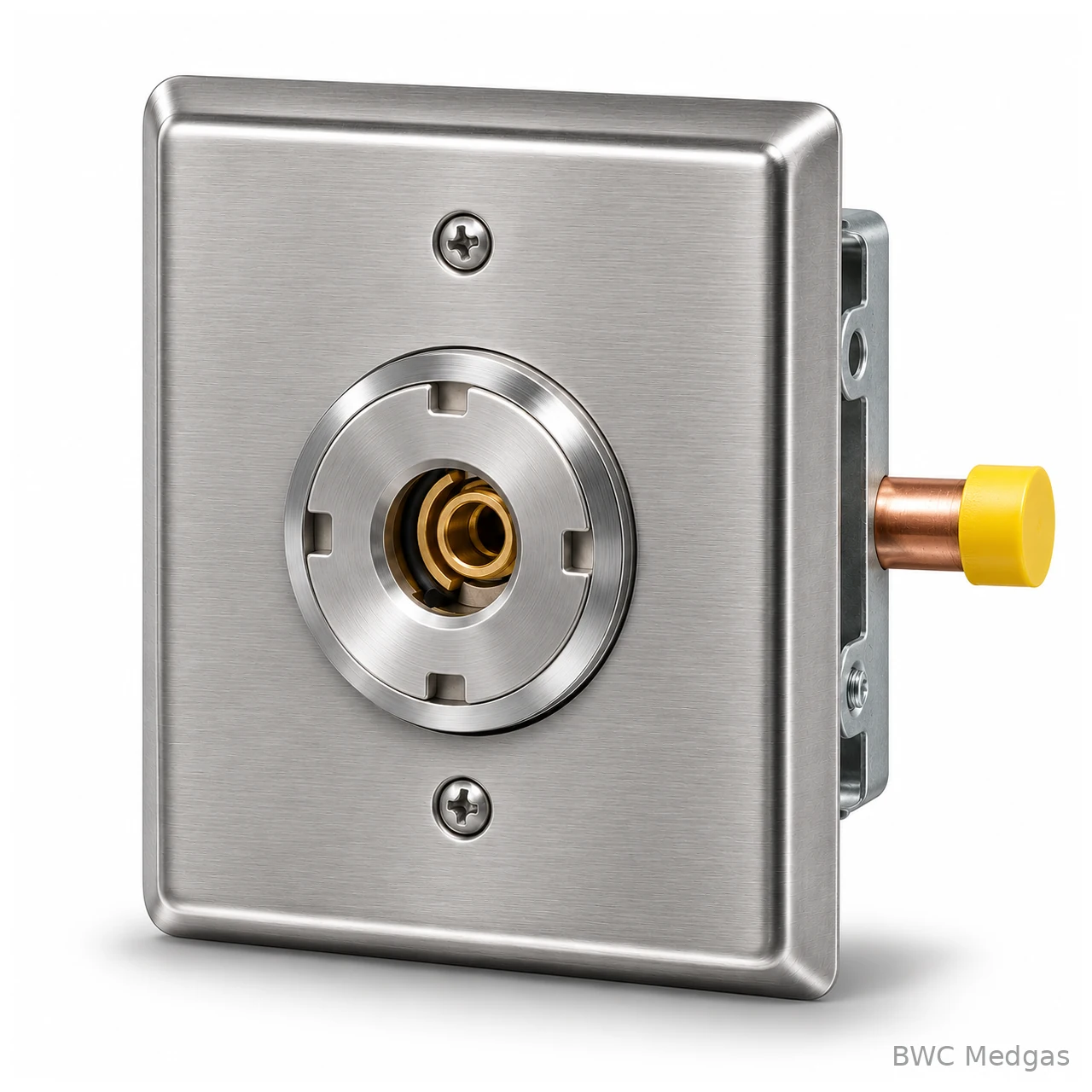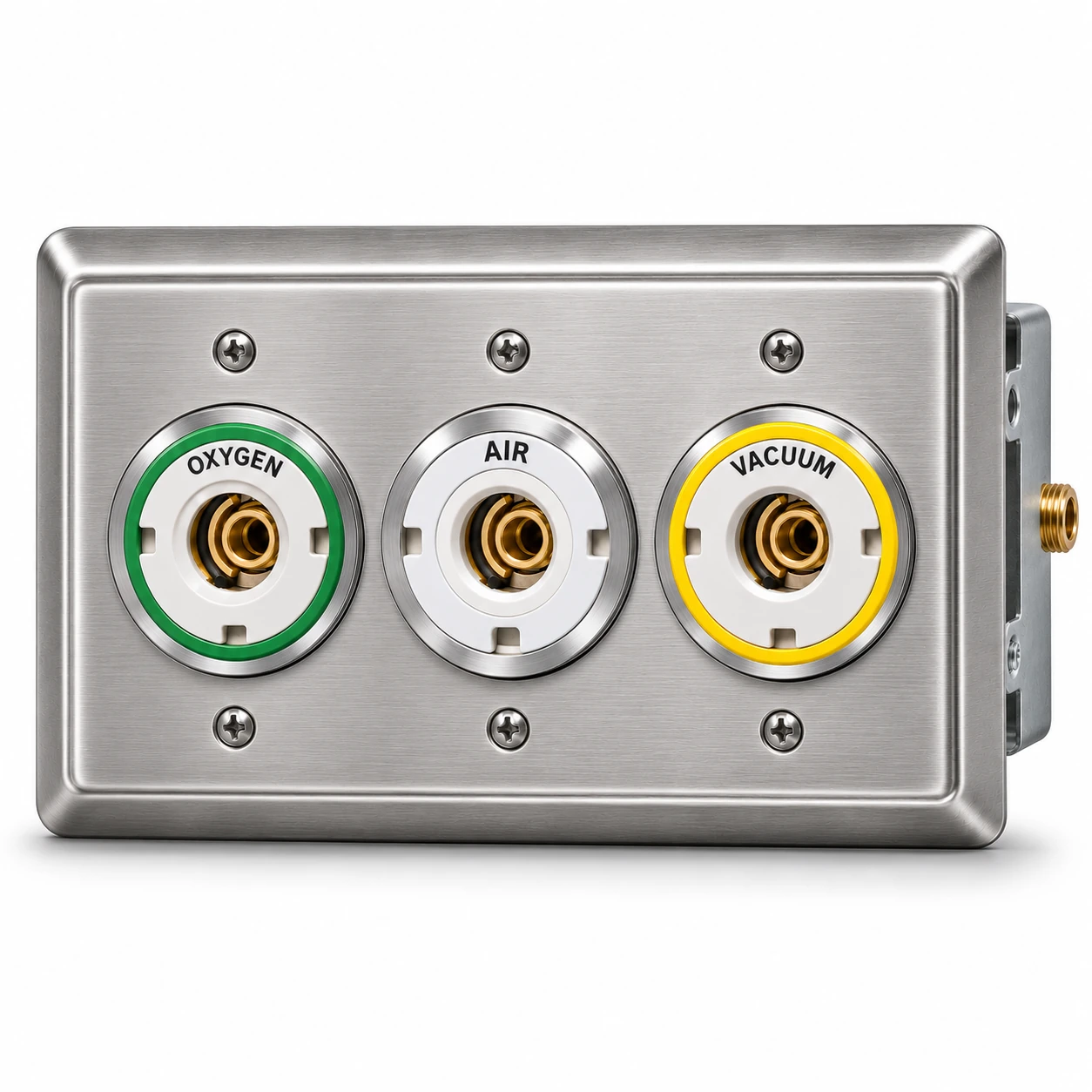
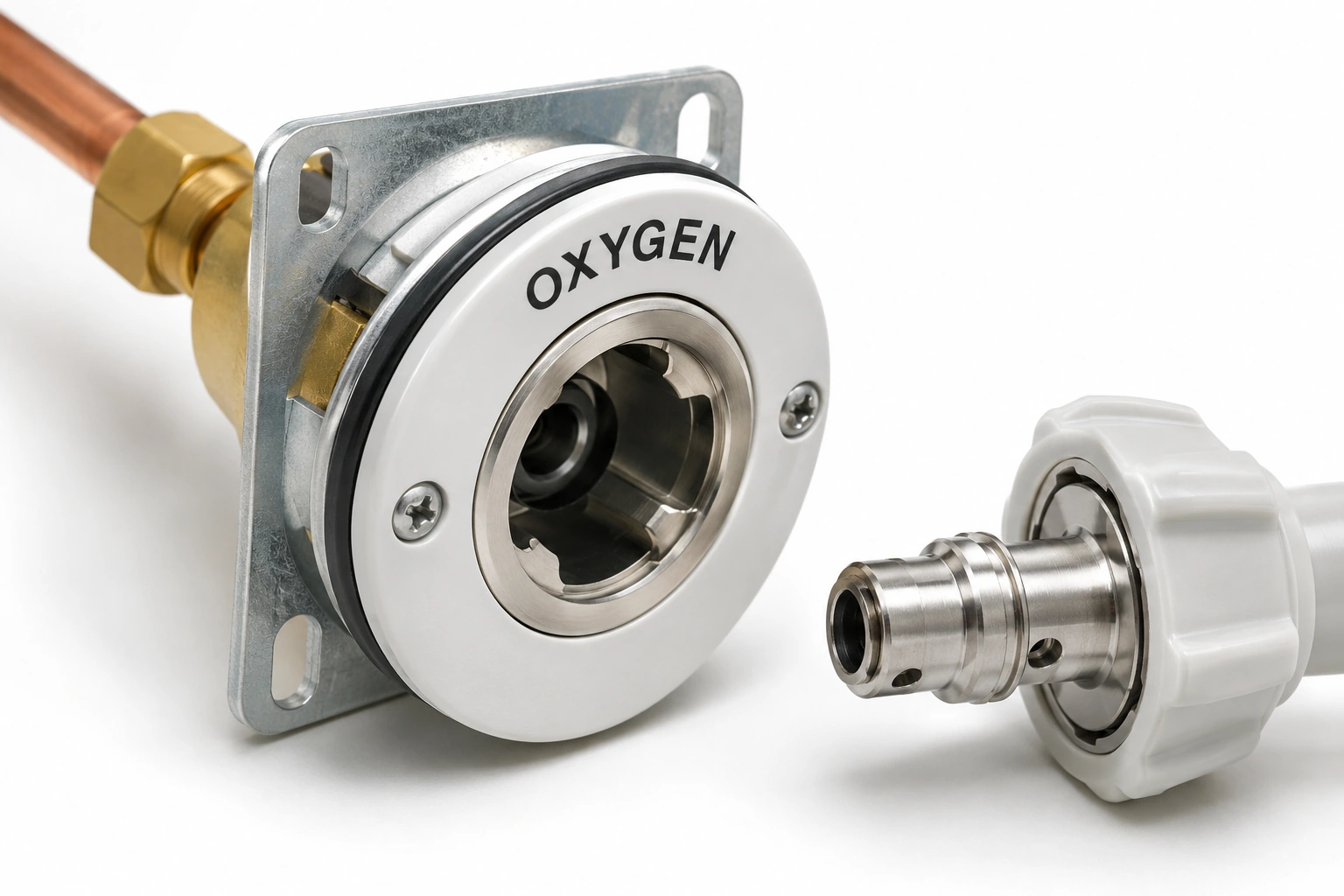
A wall outlet may look like the correct oxygen terminal yet still reject the hospital's probe or, worse, create an unsafe interface assumption. Gas identity and mechanical connector family are separate procurement fields. Both must be specified and witnessed.
ISO 9170-1:2017 addresses compressed-medical-gas and vacuum terminal units, including gas-specific assembly, strength, flow, leakage and pressure drop. ISO explicitly states that it does not specify the actual dimensions of regional probes or gas-specific connection points. Therefore “ISO 9170-1 outlet” alone does not tell a buyer whether the interface is BS, DIN, AFNOR, a national variant or another approved system.
Four separate compatibility questions
- What service? Oxygen, medical air, vacuum, nitrous oxide, surgical-tool gas or another explicitly identified pipeline service.
- What national connection family? Specify the matching outlet/probe design used by the hospital—not simply a colour in a brochure.
- What mounting format? Flush, surface, bedhead or pendant assembly; depth, fixing and pipeline-tail arrangement matter.
- What acceptance evidence? Confirm gas-specific non-interchangeability, permitted flow/pressure performance and installation verification through the adopted process.
| RFQ field | Example of a testable answer | Avoid |
|---|---|---|
| Gas service | Medical oxygen, designated pressure system | “Oxygen-like” finish |
| Probe connection | Named national interface and drawing revision | “Universal” |
| Front mechanism | Defined index, locking and release design | Appearance-only selection |
| Rear connection | Tail dimension, material and assembly layout | Unchecked adaptor |
| Performance | Model test documentation and site verification plan | Certificate with no model link |
| Spare parts | Service kit and interchangeable revision mapping | “All versions compatible” |
Why supplier photos are insufficient
A photographic front face can conceal incompatible indexing, spring mechanisms or connector tolerances. Review engineering drawings and, for critical renovations, approve a physical sample against the installed local probe family before issuing a large order. Protect patient care against a late substitution that forces staff to use improvised adaptors.
ISO 7396-1 frames system non-interchangeability and the installed network. The 2026 English HTM and 2026 Scottish SHTM each provide regional project-management context. Do not transplant a specific national terminal into another country simply because the gas label is the same.
Worked example: retrofit at an operating ward
A hospital extends a wall-head system while retaining existing bedside flowmeters. The purchasing schedule specifies oxygen, medical air and vacuum, but says nothing about probe family. Before procurement, the hospital should inventory existing terminal/probe types, identify service-specific variations and record approved connection drawings. A small sample comparison can identify a mismatch before partitions are completed.
Site verification should confirm that the fitted terminal and labelled service correspond to the intended gas, and that specified functional tests are completed by qualified staff. A successful visual inspection does not establish gas identity.
What to order
For each line include service, national connector system, wall or pendant mount, rear tail, physical dimensions, model/revision, quantity and replacement compatibility. BWC Medgas medical gas outlets and installation accessories can then be selected against the approved interface schedule rather than appearance.
Ask BWC Medgas to review an outlet and probe compatibility schedule.