
Medical air has two different reliability questions: can the plant deliver the required supply, and does the delivered gas continue to meet the hospital's quality requirements? A compressor that runs normally does not answer the second question. Neither does a clean laboratory sample prove that standby plant, alarms and distribution will perform during demand changes.
ISO 7396-1 includes medical air sources and pipeline systems. The 2026 NHS England HTM 02-01 and 2026 Scottish SHTM 02-01 establish detailed local healthcare engineering context. The site's adopted gas-quality specification and manufacturer instructions govern the necessary measurements; values should not be copied from unrelated industrial-air applications.
Keep the source and quality records separate
| Layer | Operational observations | What they cannot prove alone |
|---|---|---|
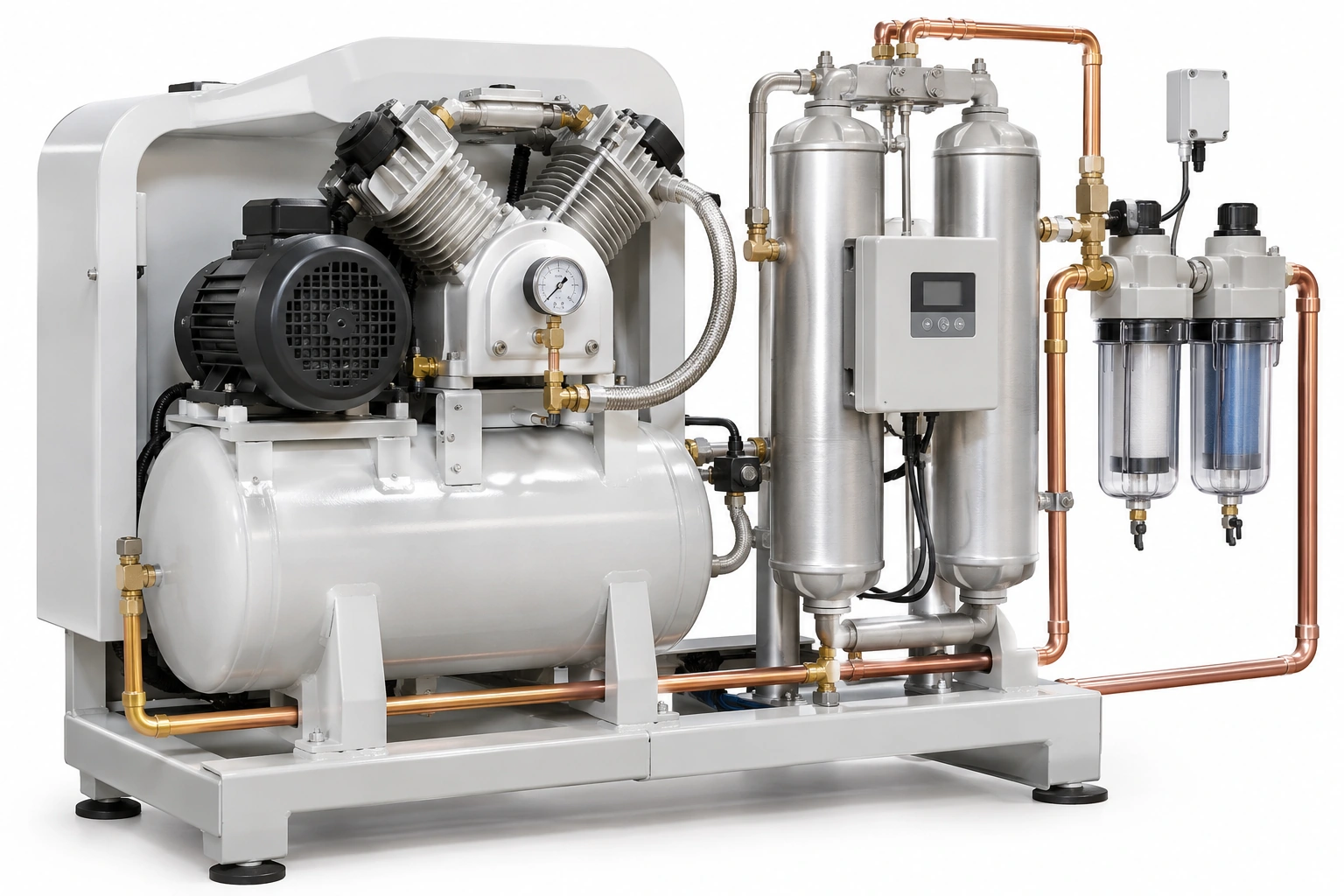
| Compressor source | Duty/standby status, runtime, faults, oil/water issues where relevant | Suitable delivered medical air quality |
| Dryer | Status, maintenance log, trend and alarms | Absence of all contaminants |
| Filtration | Change history, approved condition indicators | Gas identity or full compliance |
| Receiver/pipeline | Service pressure and demand pattern | Delivered purity at the endpoint |
| Monitoring | Sensor records and traceable sampling | Correct alarm communication without witness |
| Distribution zone | Verified service boundary and clinical usage | Condition of the entire plant |
Create links between source operating records, relevant quality evidence and the clinical distribution network. They should not be separate folders with no common timestamp or asset identity.
How to read a trend rather than a snapshot
A single acceptable reading is a useful observation but not evidence that a drifting dryer or increasingly loaded filter has no future risk. Review change in process values, duty cycles, maintenance events and environmental conditions together. Use manufacturer-defined alarm and service thresholds as adopted by the hospital; never invent a universal dryer replacement date.
Repeated start/stop cycles, increasing unplanned standby operations, rising maintenance demands or recurrent quality alerts deserve documented investigation. Record what changed and whether each event was physical, instrument-related or procedural.
Worked example: quality alert after seasonal humidity change
A hospital sees changing moisture-related indications when the plant room environment becomes more humid. The fact that the compressors continue to deliver pressure does not close the concern. The engineering team should preserve the monitoring trend, inspect documented dryer/filter maintenance and arrange appropriate verified sampling under the site's quality plan. Clinical impact and supply contingencies remain under the hospital's authorised process.
Avoid bypassing a dryer, filter, alarm sensor or standby arrangement merely to restore a dashboard to green. Such changes affect the safety assumptions of the entire medical-air system.
Plan maintenance around the complete delivery chain
At each planned review, consider the source configuration, standby readiness, process documentation, alarm response, gas quality records, replacement consumables and responsibilities for qualified tests. Any plant replacement should trigger a review of downstream pressure-control and alarm interfaces, and of the installed system's acceptance.
The [Joint Commission's 2026 maintenance strategy FAQ](https://www.jointcommission.org/en-us/knowledge-library/support-center/standards-interpretation/standards-faqs/000001340) emphasises risk-based programmes for all components of piped medical gas systems, including source subsystems and alarms. Hospitals should demonstrate why their approved schedule reflects the installed asset rather than rely on a generic maintenance calendar.
Procurement and interface boundaries
The complete medical air compressor/dryer plant is specialist source equipment. Procurement of discrete pressure regulators, medical gas valves or alarm assemblies should occur only after their connection, service environment and approved design have been confirmed.
BWC Medgas can support specified downstream component sourcing; hospital plant-operation settings, gas-quality testing and site commissioning remain under their appointed technical teams.
Discuss an approved medical-air component schedule with BWC Medgas.
What an auditor should find
A coherent file identifies equipment, approved criteria, interval rationale, trend exceptions, actual work, sample/report traceability, alarm tests, open defects and the responsible clinical/engineering acceptance. This lets a future operator understand why the plant was deemed ready instead of merely seeing a checklist stamped complete.