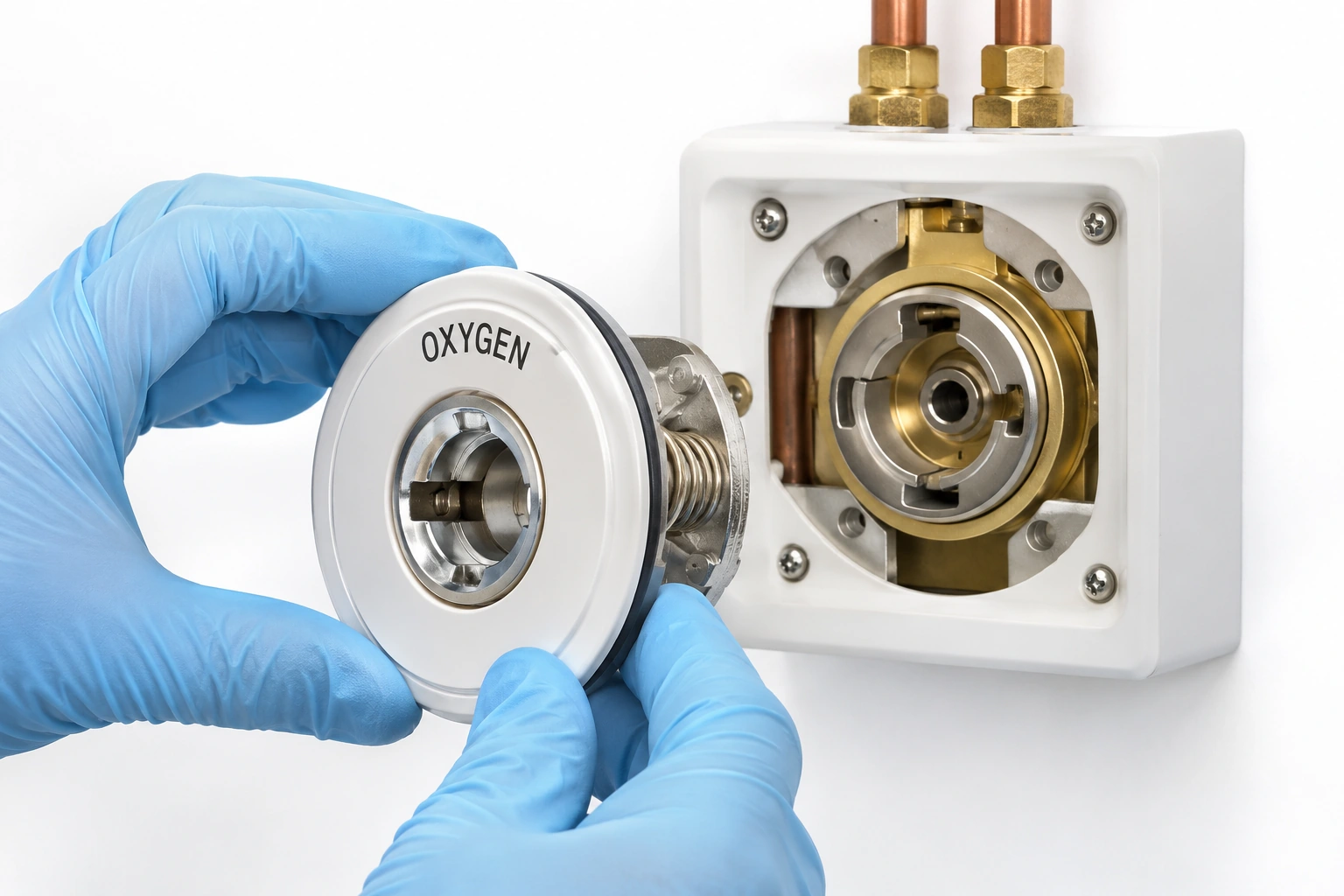
A wall outlet is the point where a carefully managed hospital gas pipeline meets clinical equipment. Maintenance must protect both correct service identity and mechanical performance. A damaged release mechanism or incompatible replacement front can undermine patient connection even when the pipeline behind it has passed a pressure test.
ISO 9170-1:2017 addresses terminal units for compressed medical gases and vacuum. It does not specify all dimensions of national or regional connector families. The 2026 English and Scottish medical gas guidance provides the site's management and verification framework.
Record what the patient actually connects to
| Field | Site record | Why it matters |
|---|---|---|
| Terminal ID | Building, room, bed or pendant identifier | Unique traceability |
| Gas/service | Oxygen, medical air, vacuum or other designated gas | Prevents cross-service confusion |
| Connection family | Named national interface and correct gas-specific probe | Correct clinical accessory fit |
| Mounting arrangement | Surface/flush/bedhead/pendant and service-tail layout | Replacement compatibility |
| Manufacturer revision | Complete model, internal mechanism and service-kit revision | Correct seal/spring replacement |
| Clinical use | Device and usage context as recorded by hospital | Risk-based scheduling |
| Defect and outcome | Observation, approved maintenance action and verified release | Demonstrates correction |
The hospital should not choose a replacement by matching just the front plate colour or a photograph.
Typical problems worth documenting
A loose front plate, stiff connection/release, visible damage, repeatedly reported disconnection, unusual noise, suspected leak or mismatch with a newly introduced clinical probe are reasons for qualified examination. Do not claim an observed symptom proves a particular seal has failed; record it as a symptom pending diagnosis.
If the clinical team reports gas delivery concerns at a single outlet, preserve the exact location, service, accessory and approximate event time. Separate device-level issues from terminal-unit concerns and upstream supply events.
A maintenance and replacement decision
The competent engineer determines whether authorised inspection, manufacturer-prescribed maintenance or a replacement is warranted. The work plan must account for the required gas-specific components, approved test procedure, potential clinical interruption and release authority.
For refurbishment work, an older regional connector family may no longer match the hospital's new equipment. Changing only one outlet may create mixed compatibility within a ward, so review the replacement strategy at the clinical department level. A probe that fits is not by itself proof of correct gas identity.
Example: intermittent suction connection
A ward repeatedly reports that a vacuum regulator becomes detached from a terminal, yet nearby outlets work normally. First reconcile the terminal model, regulator probe type and the observed event. Physical inspection and approved testing may establish wear or mismatch. Replacing the terminal without verifying the regulator's connector family may simply repeat the fault.
In an active unit, unqualified staff should not dismantle or lubricate outlet internals. Any authorised repair must follow compatible service materials and procedures, especially for oxygen service.
Verify the return to use
An approved maintenance record identifies the old/new models, location, part revision, traceable maintenance kit if relevant, gas-specific compatibility check and required functional/identity tests. Qualified verification precedes clinical release. A replaced faceplate is not evidence that the connected gas service is correct.
The [Joint Commission's maintenance strategy guidance](https://www.jointcommission.org/en-us/knowledge-library/support-center/standards-interpretation/standards-faqs/000001340) treats patient outlets as part of a high-risk piped-system inventory. Site policy and applicable standards determine the maintenance method and frequency.
For repairs, BWC Medgas can review medical gas terminal units and installation accessories against an approved drawing, connection family and spare-part list.
Send the exact outlet and probe requirements to BWC Medgas.
Recommended asset closeout
Keep the incident observation, model comparison, approved work order, test results and staff notification associated with the same terminal ID. Review clusters of similar defects by manufacturer revision rather than treating every ward report as unrelated.