
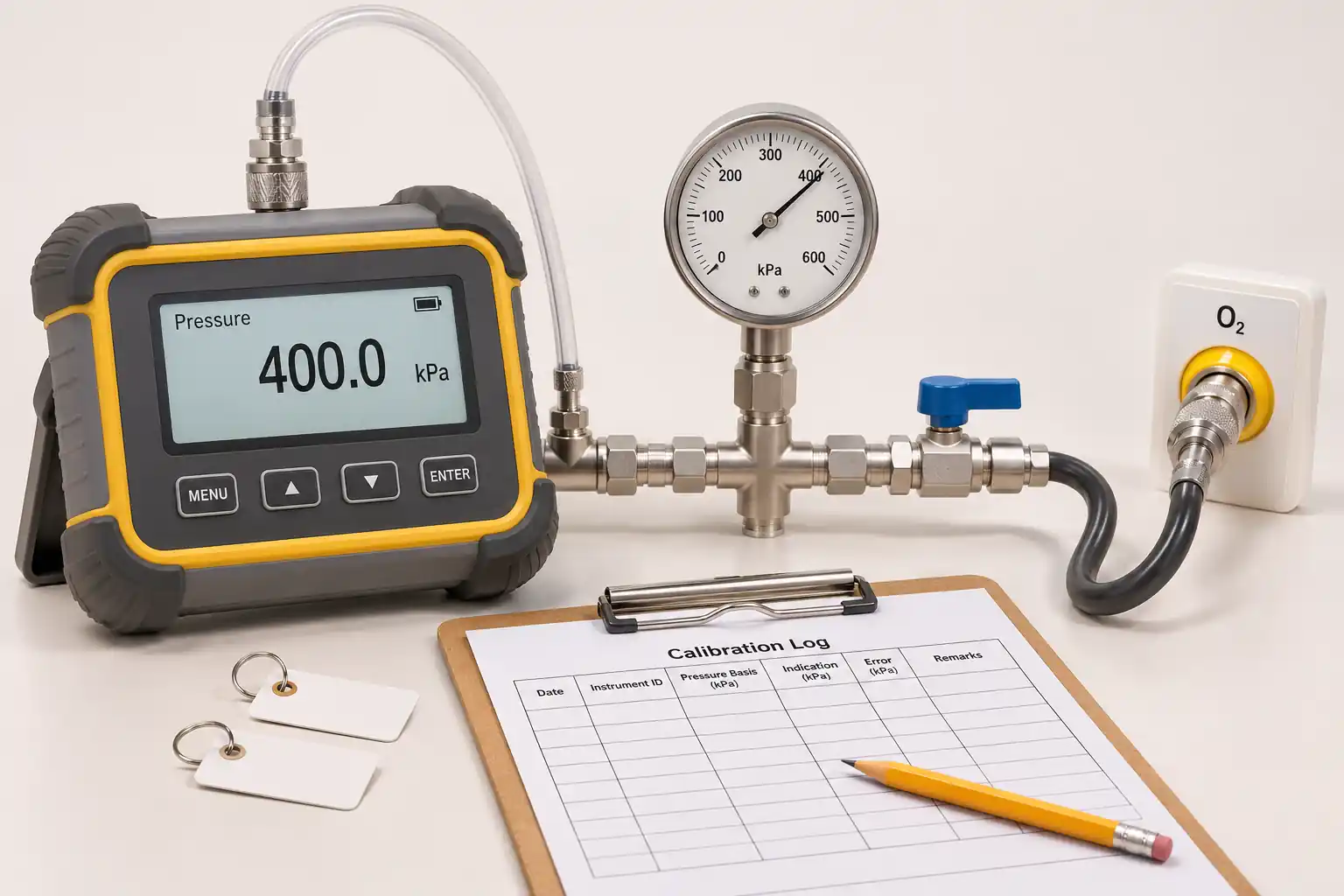
Even a carefully performed MGPS commissioning test can become difficult to defend if the pressure gauge, flow meter or gas analyzer has an unclear measurement reference or an expired calibration record. A number on a certificate is only useful when the project knows what was measured, where, under which conditions, with which instrument and against which accepted requirement.
This article helps project teams create an instrument-and-sampling register that can support multiple different tests without implying that one meter or one calibration document is appropriate for every medical gas service.
Establish the required quantity first
Pressure, vacuum, flow, oxygen concentration and particular contaminants represent different physical quantities with different equipment limitations. Gauge versus absolute pressure must be identified explicitly, especially when records use both negative pressure and vacuum magnitude.
A calibration certificate for a pressure instrument does not establish its suitability for a gas analyzer or vacuum test. Nor does an instrument's advertised resolution prove that total measurement uncertainty is small enough for a specific acceptance limit.
Test-measurement traceability matrix
| Required field | What to document | Review question |
|---|---|---|
| Test ID | Exact SHTM/project test and service | What is being established? |
| Instrument ID | Model, serial, relevant measuring range | Is it the instrument actually used? |
| Calibration basis | Certificate date, conditions and traceability | Valid for this application? |
| Reference | Absolute, gauge, vacuum magnitude or concentration | Is comparison meaningful? |
| Sampling location | Plant, branch, valve or terminal reference | Does it cover the claimed area? |
| Site conditions | Relevant ambient/test conditions | Can results be interpreted? |
| Acceptance source | Approved test procedure/edition | Is the limit supported? |
| Observation | Raw reading, units, required correction and outcome | Was the decision justified? |
| Witness and control | Person, date, record revision | Is the evidence auditable? |
Keep a master instrument register but always copy the applicable instrument and test identifiers into the individual test record.
Read the acceptance boundary carefully
NHS Scotland SHTM 02-01 (2026) lists separate forms covering pressure and vacuum integrity, terminal function, plant performance, particulate tests, purging, gas identification and gas quality. Different form types require different method and measurement evidence.
The point is not to put a generic “all instruments calibrated” note at the start of a thick handover dossier. Record which devices were used in each individual accepted test.
Example: confused pressure scale
A medical vacuum reading is recorded as a positive magnitude in the source equipment controller while the test sheet expects negative gauge pressure. Both could refer to the same physical state, but the numerical comparison is invalid until the reference and units are reconciled.
The tester must use an accepted conversion and documented method. A spreadsheet cell that silently reverses the sign is not acceptable evidence.
Example: sampling at the wrong location
A contractor provides a gas quality measurement from the central supply but uses it to certify a newly installed terminal branch. Even with a well-calibrated analyzer, that result cannot automatically represent the branch.
The verifier should identify the correct accepted sampling coverage and any needed terminal/system test, leaving the original source measurement in the record for what it actually demonstrates.
Uncertainty is not an excuse to ignore failure
When a test result lies close to an acceptance boundary, the testing authority should apply the project's recognized method and decision rule. Arbitrary rounding to make a result pass hides important uncertainty.
The relevant procedure may specify the required accuracy or instrument category. Use it rather than assigning a universal precision value across pressure gauges, flow devices and gas analysis equipment.
Preserve failures and recalibration history
If an instrument is discovered out of calibration after a commissioning period, identify which records could have been affected. The quality authority should decide on retrospective review and any required retesting.
Do not alter raw observed readings to reflect later calibration. Keep the original evidence and document the accepted corrective disposition.
Standards and operational governance
ISO 7396-1:2016 requires qualified verification in the context of MGPS design, installation and operation. NHS England HTM 02-01 (2026) provides the hospital operational and validation structure. The adopted project specification governs actual instrument suitability.
ISO 9170-1:2017 covers product-level terminal characteristics, but a manufacturer's terminal test certificate does not replace traceable site measurements of the installed connection.
Purchasing implications
A useful component submittal identifies the exact pressure regulator and gauge model, measurement range, calibration or conformity documentation and supplied interface. Avoid choosing a gauge from dial colour alone.
BWC Medgas can quote component-specific gauges, regulators and terminals while the project test authority maintains commissioning measurement traceability.
Send the approved instrument or component schedule to BWC Medgas.
Frequently asked questions
Can one calibration certificate cover every instrument used on site?
No. Each instrument and applicable measuring range require traceable identification.
Does a calibrated meter prove that an installed medical gas network passed its tests?
No. The tested physical boundary, method, readings and qualified acceptance must also be documented.