
Pressure integrity tests are often presented to hospital project managers as one universal “leak test.” That shorthand can conceal important differences: a first-fix carcass section, the fully assembled second-fix distribution system, a vacuum circuit and an individual product are not necessarily subject to identical methods or acceptance criteria.
Scottish SHTM 02-01 (2026) labels Form A3 for second-fix pressure and vacuum leakage testing. The practical goal is to maintain an intelligible chain of evidence that tells the next project team what was actually assembled and tested.
Define the completed configuration
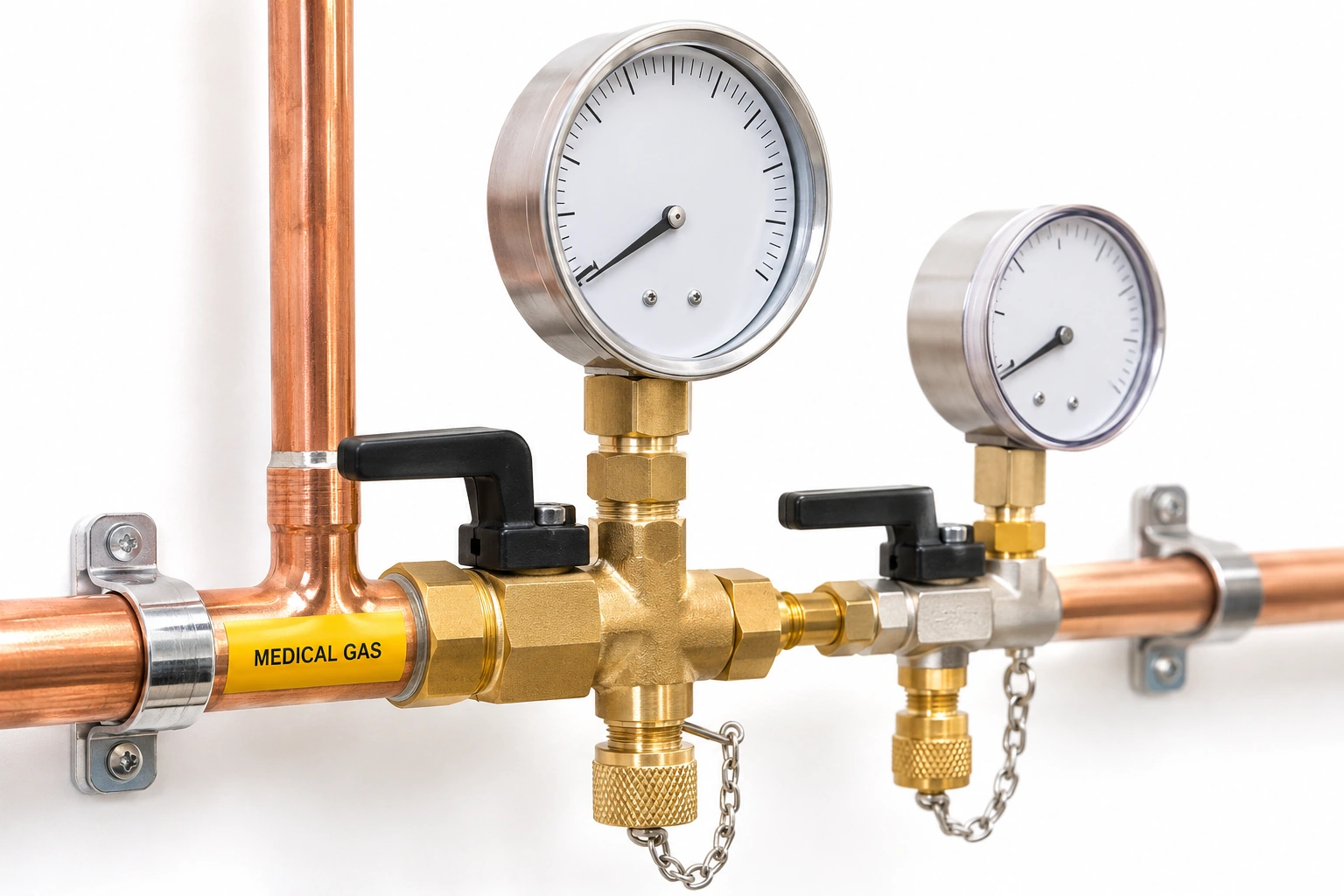
Identify the precise system service, source boundary, relevant zone/branches, terminal assemblies and any installed test fittings. Record whether the procedure involves compressed medical gas or vacuum equipment and which portions are protected, isolated or specifically excluded under the approved plan.
Do not let a tester mark “whole network” when a branch is intentionally disconnected or scheduled for a later building phase.
A3 record fields
| Register field | Required description | Purpose |
|---|---|---|
| Service | Gas, medical vacuum or defined separate circuit | Prevents ambiguous records |
| Test configuration | Approved installed section and accessible end points | Establishes scope |
| Test procedure | Authorized method/version and controlling documents | Traceability |
| Instrument | Model, serial, range, calibration evidence | Measurement confidence |
| Conditions | Applicable test conditions and approved limits | Valid comparison |
| Observations | Readings, duration, site circumstances as required | Reproducibility |
| Defects | Leak location and evidence where found | Corrective action |
| Witness/approval | Qualified tester and accepted sign-off | Responsibility |
The test procedure—not an online article—defines the actual pressures, durations, allowable changes and safe isolation methods.
Do not equate vacuum and positive pressure
A negative-pressure circuit and a compressed-gas network may require different verification methods. Incorrectly expressing vacuum as positive magnitude or mixing gauge and absolute pressure units can produce a nonsensical result.
State the measurement reference and units used by the approved procedure. Instruments that are calibrated for one pressure range should not be assumed appropriate for a different system duty.
Distinguish product conformity from installed acceptance
A manufactured medical gas outlet may be type-tested under ISO 9170-1:2017, but this does not prove that its installed connection to the pipeline is leak-free. Conversely, a sound pressure test does not automatically prove that the terminal accepts only the right gas-specific probe.
Those topics belong to different evidence tasks within the integrated pipeline commissioning plan.
Example: late pendant installation
An operating-room pendant arrives after the second-fix test. The contractor reconnects a previously capped connection and considers the system finished because “the pipe test already passed.”
The installed configuration has changed. The relevant authority must identify what inspection and retesting are necessary for that new portion, then record a version-controlled result. A historical form cannot certify connections that did not yet exist.
Quality control after corrective work
The defect record should show precise location, observed failure, authorized repair, affected boundaries, subsequent test record and closure approval. Avoid silently replacing the failed sheet with a clean copy.
If multiple test documents cover overlapping sections, link them rather than making auditors guess which is the final accepted version.
Coordination with operating hospitals
Second-fix work in an occupied hospital requires clinical coordination and an approved service continuity plan. Never treat a test pressure or planned isolation as authority for a live clinical interruption.
ISO 7396-1:2016 covers extensions and modifications as well as new pipeline systems. NHS England HTM 02-01 (2026) gives current UK operational and testing governance; projects elsewhere must follow their adopted code and local safety rules.
Buying and equipment planning
An approved second-fix schedule clarifies the quantity and type of zone valve assemblies, test connection fittings, terminal outlets and replacement seals. It should not authorize substituting incompatible gas-specific connections.
BWC Medgas supplies selected components, not the independent commissioning certificate for an installed hospital MGPS.
Submit your approved second-fix component requirement to BWC Medgas.
Frequently asked questions
Does the A2 first-fix certificate replace the A3 second-fix acceptance?
No. They represent different installed configurations and verification boundaries.
Can a vacuum leakage test use the same method as an oxygen pipeline pressure test?
Not by assumption. Follow the correct adopted procedure for the exact service.