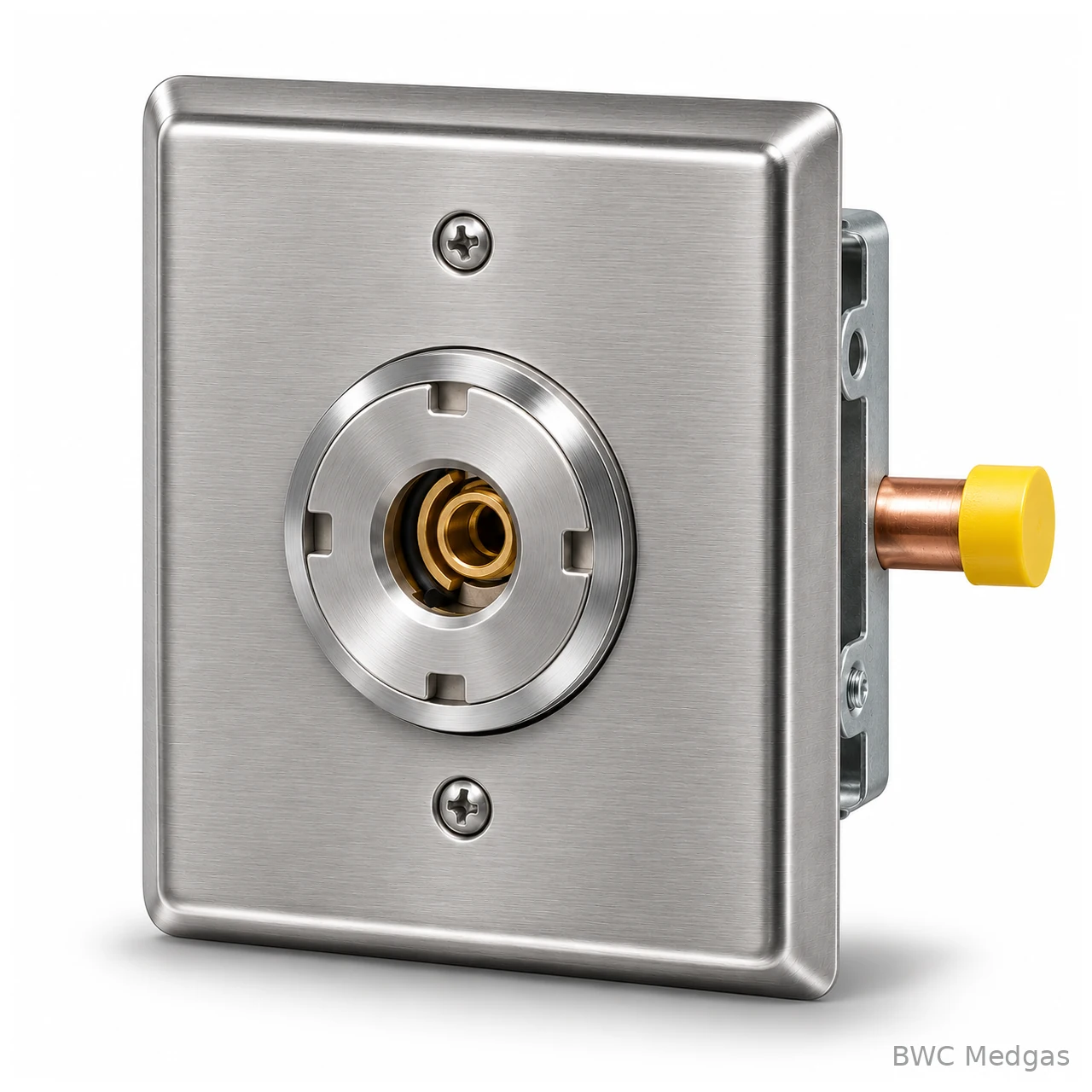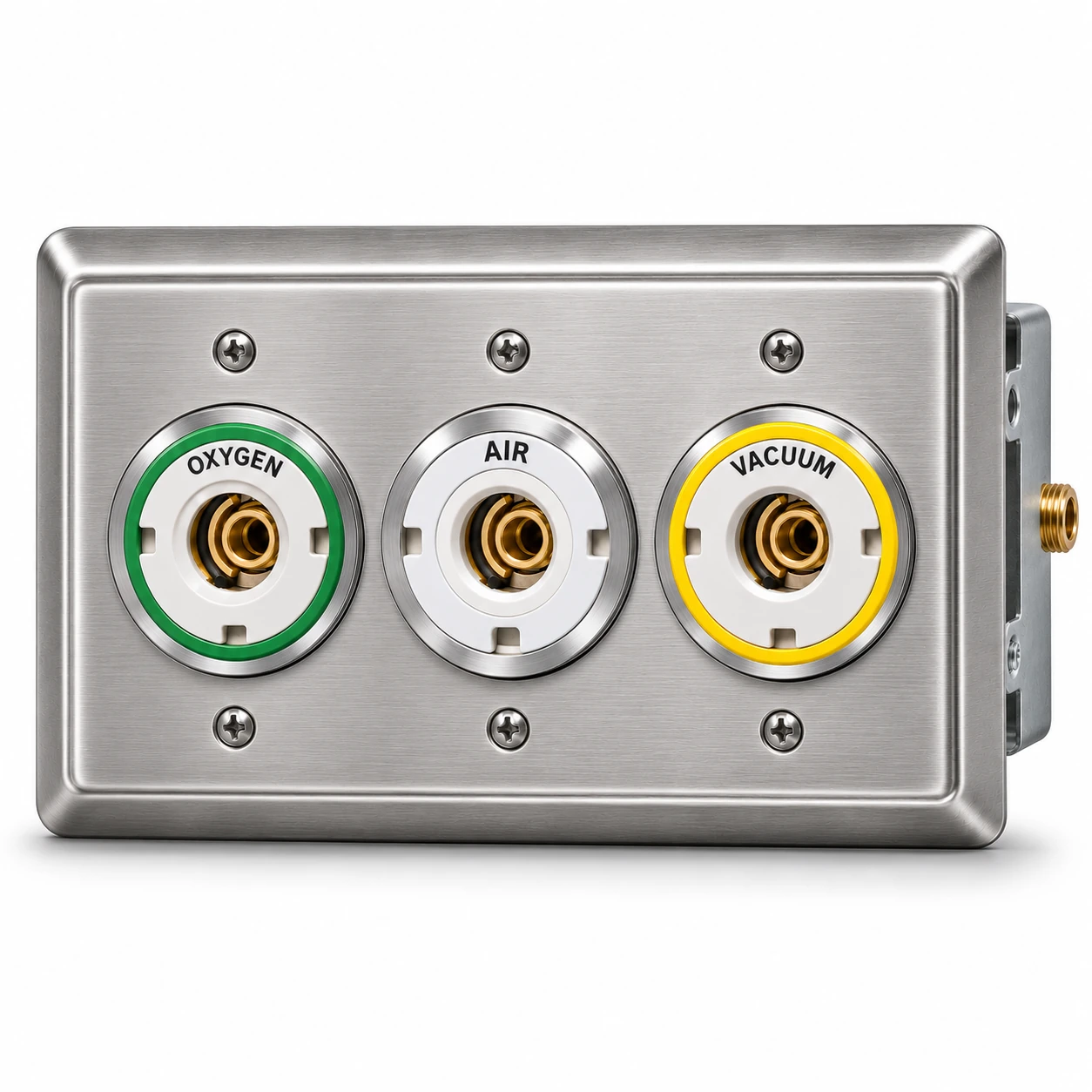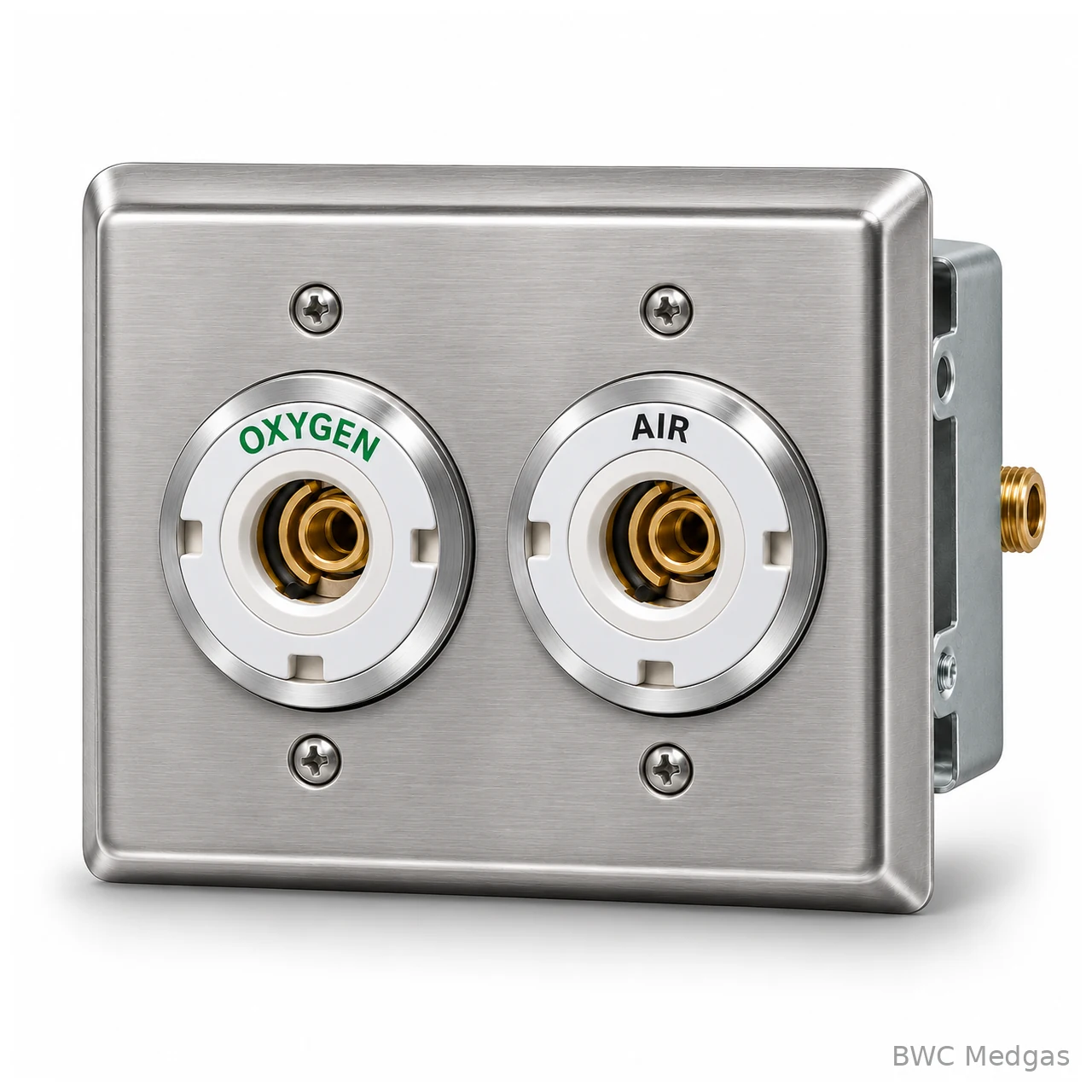
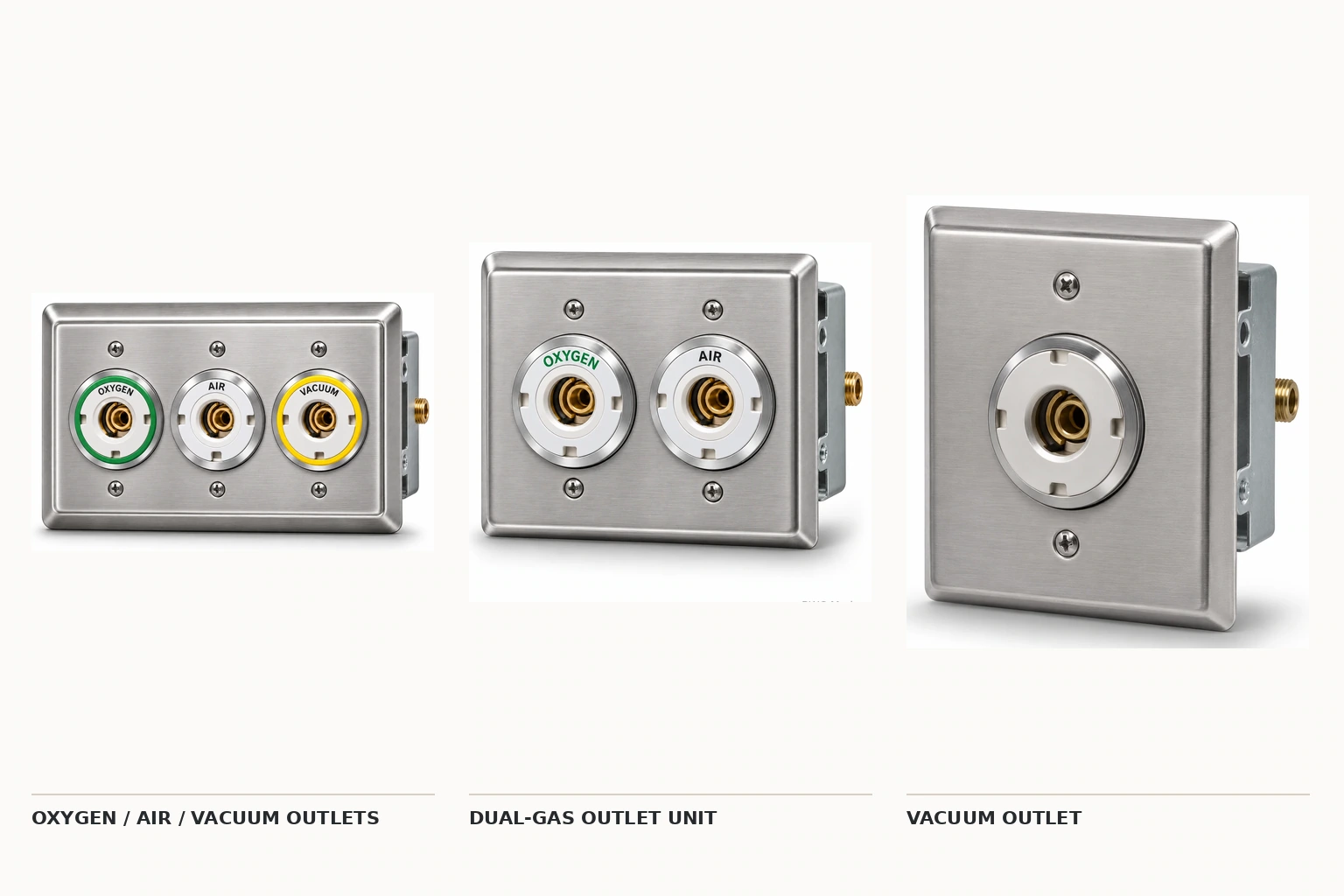
A medical gas outlet is not an interchangeable general-purpose connector. It is a terminal unit associated with a designated medical gas or vacuum service, and the connection to its mating probe or adaptor is an important part of preventing service mix-ups.
ISO 9170-1:2017 is an international standard covering terminal units for use with compressed medical gases and vacuum. Its published abstract identifies gas-specific assembly and non-interchangeability among the central aims, alongside mechanical resistance, flow, leakage and pressure-drop requirements.
What does gas-specific mean at the connection?
At a practical level, an outlet and its intended mating connector should correspond to a defined gas or vacuum service. The system must avoid treating an oxygen terminal as an equivalent connection for medical air or vacuum simply because the visible front plates look similar.
The terminal, the probe and the service identification all matter. Product pictures alone are not sufficient to establish whether a new outlet will mate correctly with an installed connector.
Gas-specific construction is therefore more than a label. It is part of the physical interface addressed by the applicable standard and system design.
What is the difference between a terminal unit and a probe?
A terminal unit is the connection point incorporated into the medical gas supply arrangement at the place of use. A probe or mating connector is the corresponding connection intended to engage with it.
ISO 9170-1:2017 covers both relevant terminal units and probes intended to connect to gas-specific connection points. The standard also explains that national or regional documents may specify the dimensions of particular probes and connection points.
This matters when a hospital replaces outlets in one ward but retains existing equipment and hoses.
Does ISO 9170-1 define all national connector dimensions?
No. The published abstract explicitly notes that ISO 9170-1 does not specify the dimensions of probes or gas-specific connection points, and points to national or regional connection standards for such dimensions.
It would therefore be incorrect to treat a general 'ISO 9170-1 outlet' label as sufficient proof that two connection families mate mechanically. The selected service, connector family and physical interface must be established from the project and model information.
How should a buyer prepare a replacement-outlet enquiry?
For an existing medical gas installation, the useful technical questions are:
- Which gas or vacuum service is assigned to the outlet?
- What connector or probe family is already installed and must remain compatible?
- Does the replacement use the same mounting arrangement and panel dimensions?
- Is the gas-specific mating probe supplied separately?
- What is the required quantity by service, not merely the total number of sockets?
- Are there existing drawings or clear photos of both outlet and mating connector?
These questions guide a procurement discussion. They do not authorize altering, adapting or bypassing gas-specific fittings on an installed system.
Are terminal units and complete pipeline systems covered by one standard?
The relevant documents are related but have different scope. ISO 7396-1:2016 addresses requirements for broader medical gas and vacuum pipeline systems, while ISO 9170-1:2017 addresses terminal units used within specified applications.
That is one reason a complete hospital technical specification may reference several standards: system requirements and individual component requirements are not identical subjects.
BWC Medgas outlet and connector enquiries
BWC Medgas offers medical gas outlet products, including terminal configurations for different project connection requirements. Our product catalogue also includes related medical gas valves, zone valve units and gas-flow equipment.
When requesting a quotation, please send the gas-service list and confirmed terminal/probe connection family. For replacement projects, include the existing interface details and mounting drawings. Use the BWC Medgas contact form to submit a structured enquiry.
Common questions
Can medical oxygen and medical air use the same mating probe?
Gas-specific non-interchangeability is a central requirement for the relevant terminal-unit systems. The actual mating connection for each service must match the specified interface and applicable standards.
Is a connector marked for a national style always compatible with another model?
A country or style label alone is not sufficient evidence. Compatibility depends on the defined probe and terminal connection details.
Does a photo prove interchangeability?
No. A photograph can help identify a candidate connector family, but drawings and matching interface information are needed for a reliable replacement specification.
Primary references
- ISO 9170-1:2017 — Terminal units for medical gas pipeline systems. Published scope for gas-specific terminal units and probes, including its limitation concerning probe dimensions.
- ISO 7396-1:2016 — Medical gas pipeline systems, Part 1. Published scope of wider pipeline distribution and non-interchangeability.